


China’s prosperity today stems from reform, opening up, and becoming the factory of the world. It got a lot of things right, but the single most critical step was joining the World Trade Organization (WTO).
In theory, led by the late Premier Zhu Rongji’s expert team and masterful diplomacy, China secured agreement from the Clinton administration back in 1999. But when George W. Bush took office in early 2001, Washington was already viewing that deal as a strategic mistake and looking to overturn it.
Before September 11, 2001, China’s actual entry into the WTO hung by a thread.
Then, the Black Swan arrived.
The familiar narrative goes like this: China’s then-President Jiang Zemin overruled internal opposition and immediately called Bush, putting China firmly on the side of the American war on terror. Deeply moved, Bush removed China from America’s target list. By late 2001, China joined the WTO as scheduled, triggering two decades of steep economic growth.
That is how events played out on the surface. But the mechanics behind deserve a closer look and a bit of explanation.
1. China’s 180-Degree Pivot
Jiang calling Bush to offer public support was no simple decision at the time.
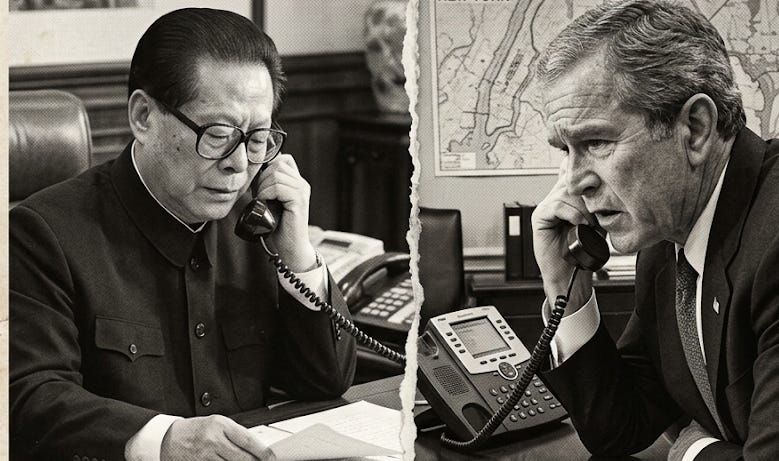
You have to know, the U.S. bombing of the Chinese embassy in Belgrade in 1999 was followed by the Hainan Island mid-air collision in 2001, sparking intense anti-American protests across China. In his speeches, Jiang even used the phrase “American imperialism”—an ideological term that had been retired for years.
In other words, the hostility between the U.S. and China back then was far more dangerous than anything seen in the so-called “New Cold War” under either of Trump’s terms.
Pivoting from that level of hostility to immediate support was a full 180-degree turn.
2. What Did That Call Mean to the U.S.?
Looking at post-WWII American military history, there is a clear pattern:
Every war the U.S. won had no major power undermining it from behind.
Every war that ended in defeat (Vietnam) or a stalemate (Korea) had China and the Soviet Union backing its enemy.
Before sending 500,000 troops into Afghanistan, Bush needed absolute certainty that no major power would stab America in the back.
Thanks to that phone call, America’s enemies in Afghanistan and the Middle East didn’t receive an endless supply of Soviet AK-47s, anti-aircraft weapons, or Chinese logistics. The U.S. military overthrew the Taliban in months and swept through Iraq to oust Saddam with ease.
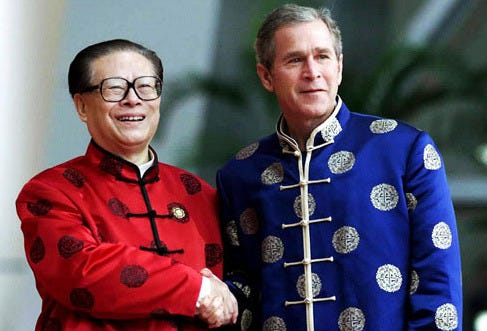
This explains how Bush went from campaigning on a harsh anti-China platform to wearing a traditional Tang suit at the 2008 Beijing Olympics.
3. The Forgotten Player: Putin’s Call
The Chinese official narrative always credits Jiang with “grand vision” and “overruling opposition,” as if he pulled off a lone, masterfully calculated strategic move.
But add Russia and Putin back into the script, and the story changes.
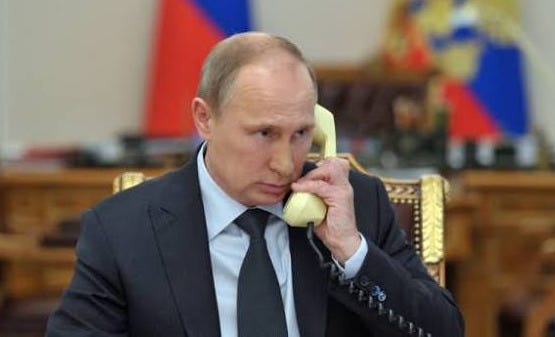
The critical timing detail: Putin also called Bush, and he did it before Jiang. In fact, Putin was the very first foreign leader to call Bush—earlier than China, and earlier than Britain.
Putin had already given the green light for U.S. forces to enter Central Asia.
With Russia already on board, China’s endorsement was certainly important, but it was no longer an indispensable “either/or” pivot. Bush was still moved to tears, remembered the gesture, and repaid it by greenlighting China’s WTO accession. But for Beijing, this wasn’t so much a “stroke of prophetic genius” as it was a smart follow-up bet made after another player had already put their chips on the table.
This is one of the most interesting, yet most overlooked, moments in modern history.
4. A Duplicitous “Good Luck”
When both Russia and China backed the U.S., and 500,000 American troops marched into the “Graveyard of Empires,” did China actually want a quick U.S. victory?
Of course not.

Zhang Zhaozhong, a well-known military commentator on Chinese state TV, spent that era predicting American defeat from Afghanistan to Iraq. His view reflected the mainstream mindset inside China: most believed the U.S. military would be beaten by Taliban guerrillas or Saddam’s Republican Guard using Mao Zedong’s playbook, drowning in a “vast ocean of people’s war.”
Beijing’s official stance said “we stand with you,” but the unspoken thought was: Good luck—hopefully you get stuck in that quagmire for ten or twenty years.
In a way, Zhang wasn’t entirely wrong:
American military efficiency in the early stages was far higher than expected in both Afghanistan and Iraq, leaving enemies helpless.
But we all know the ending—once the mission expanded into nation-building and counterinsurgency, the U.S. did get bogged down in the Middle East for two full decades.
5. Nobody Gets it 100% Right After a Black Swan
When looking back, we love labeling victors as visionaries. In this case, the story claims Jiang foresaw everything while Bush was blind to the future. That isn’t true.
Real history is driven by Nassim Taleb’s Black Swans. In those chaotic hours following 9/11, amidst the fog of crisis, no one could predict the next twenty years. You make decisions with the limited options on your plate, and you are never the only player at the table. In the immediate wake of a Black Swan, emotion takes over, attention narrows, and even the sharpest minds are focused entirely on the fire right in front of them.
Trump today often slams Clinton for letting China into the WTO as a mistake, but he clearly misunderstands this piece of history. Had he been transported back to that trading moment in 2001, facing that incoming Black Swan, he wouldn’t have played the hand any better than Bush did.
Looking back on all of this, I find Putin’s phone call to be the most intriguing part. Mainly because, while all the other players have walked off the stage of history, he is remarkably still here.
And reflecting on the triangular relationship between China, Russia, and the United States:
a lot of things seem to have changed,
yet some certain fundamental realities remain the same.