

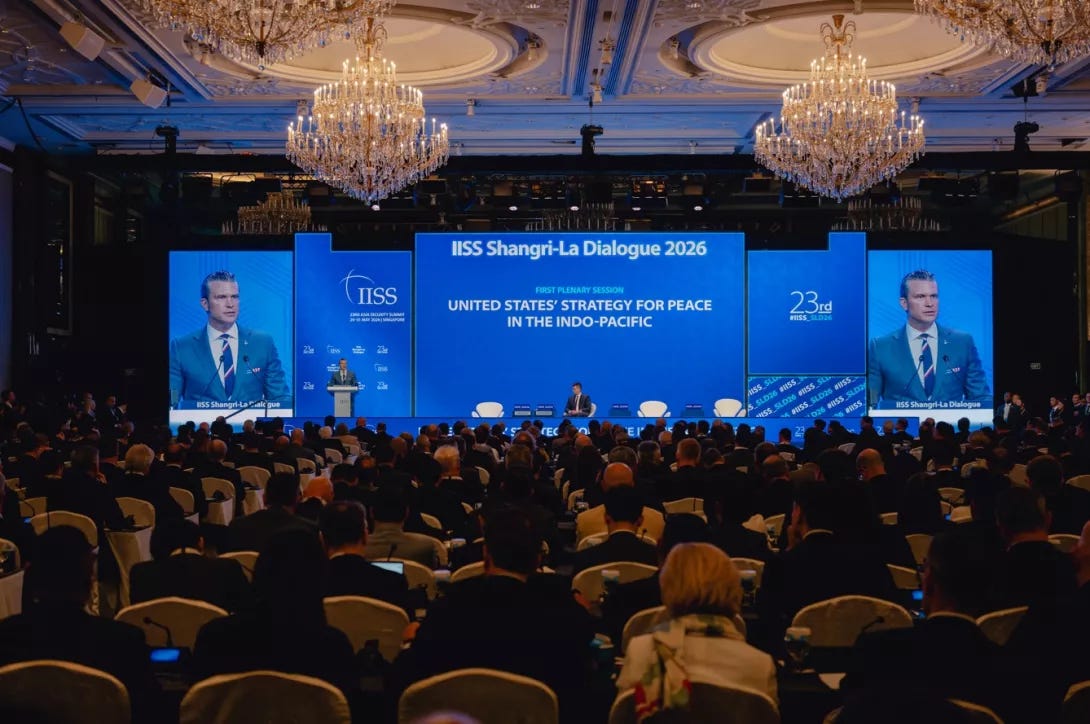
The Asia-Pacific geopolitical landscape in mid-2026 sits at an exceptionally delicate crossroads. The recently concluded 23rd Shangri-La Dialogue presented a spectacle that puzzled many observers accustomed to the rhetorical fireworks of previous years: a distinct, almost eerie “calm.” Compared to past iterations where geopolitical friction nearly upended the diplomatic table, this year’s agenda and atmosphere seemed cushioned, with open disputes and rhetorical volume deliberately dialed down.
To understand this superficial warmth, western audiences must look past standard press releases and recognize that multilateral security forums operate on two parallel, symbiotic structural logics:
The Logic of Alignment and Targeting: A cold-war framework where Shangri-La acts as an “Asia-Pacific Munich Security Conference” to encircle Beijing.
The Vienna Table Logic: A pragmatic philosophy where arguing at a dinner table is infinitely preferable to shooting on a battlefield.
The first is the “logic of alignment and targeting,” a cold-war framework intimately understood and deeply guarded against by great powers like China and Russia. From this perspective, the Shangri-La Dialogue has irreversibly taken on the characteristics of an “Asia-Pacific Munich Security Conference.” Just as Munich’s primary function is to consolidate the Western bloc and calibrate its strategic crosshairs toward Russia, the implicit undercurrent of Shangri-La is the collective balancing and direct confrontation against China. It is a high-stakes arena where great powers lay out their positions and test each other’s red lines.
Yet, the reason the forum does not collapse into outright dysfunction is that a second framework operates with equal force: the “Vienna table logic,” long cherished by Western institutionalists, NGOs, and the academic establishment. Tracing its lineage back to the Congress of Vienna in 1815, its underlying philosophy is starkly pragmatic: arguing at a dinner table—even exchanging superficial handshakes—is infinitely preferable to shooting on a battlefield. Here, multilateral protocols, legalistic rhetoric, and dialogue mechanisms serve as a vital shock absorber for geopolitical friction.
The most compelling reality of contemporary diplomacy is that both the great powers who view the forum through the cold lens of the first logic, and the international institutionalists who cling to the second, have reached a tacit consensus. This is a recurring pattern in diplomatic history: just as Russia remained a long-term participant in the Munich Security Conference—with Vladimir Putin famously utilizing that specific lectern to fiercely denounce NATO’s eastward expansion—China continues to show up at Shangri-La despite being fully aware of its institutional alignment. All regional actors gathered in Singapore because they have calculated a pragmatic strategic balance sheet: the return on “showing up to counter narratives and dismantle opposing maneuvers within the rules” far outweighs the strategic vacuum left by an angry boycott. For any regional player, the price of absence is far more damaging than the transactional humiliation of showing up.
Intertwined by these two competing impulses, the 2026 Dialogue transformed into the highly calculated, nuanced, and double-edged drama we observed. Every defense official’s performance on stage was driven not by naive pacifism, but by a cold appraisal of domestic political survival and national interest.
1. The Titans’ Intermission: Sino-US Relations and the Tacit Truce
In mid-2026, against a backdrop of endless think-tank predictions regarding a “2027 Taiwan Strait flashpoint,” the topic of Taiwan was unexpectedly marginalized at this year’s Shangri-La Dialogue. This conspicuous absence directly mirrors the recent summit between the Chinese and US heads of state, reflecting a broader geopolitical “intermission.” Having engaged in an exhausting, comprehensive trial of strength, the two titans have chosen to take a half-step back to stabilize their respective positions.
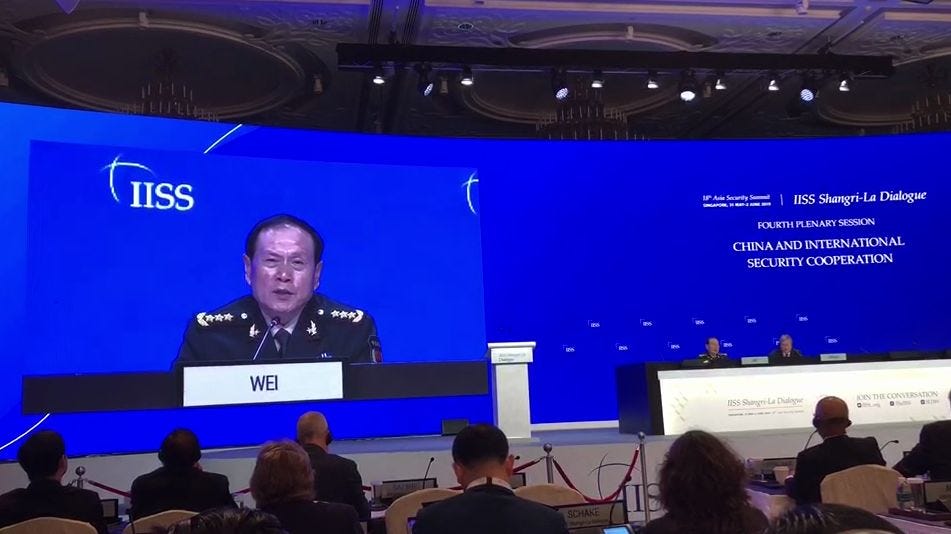
For Beijing, this intermission manifests as a highly patient posture of “defensive diplomacy.” China not only refrained from sending its Minister of National Defense to Singapore, but it also conspicuously downgraded the overall rank of its delegation. This tactical step-back is rooted in a hard domestic reality: the senior leadership of the Chinese military has recently undergone a profound anti-corruption purge and internal reorganization. In this current phase, the internal alignment of the command structure and the recalibration of combat readiness take absolute precedence over external strategic friction.
When viewed through a longer historical lens, this current “defensive” posture reveals a dramatic tactical shift. Since General Liang Guanglie broke the mold by personally attending the dialogue in 2011, the Chinese military’s stance on this multilateral stage has followed a sharp trajectory from quiet observation to assertive counter-offensive. In recent years, Chinese delegations consistently utilized the forum to issue uncompromising warnings on Taiwan and the South China Sea, declaring a willingness to fight at all costs and transforming Shangri-La into a literal rhetorical ring. The lower-profile delegation of 2026, therefore, represents a calculated tactical cooling.
Simultaneously, Washington has executed its own strategic pivot. Historically, a US Defense Secretary’s arrival at Shangri-La signaled a geopolitical charge. From Robert Gates in 2007—the first US defense chief to attend—to the Obama era under Leon Panetta and Chuck Hagel, Washington systematically treated this forum as the premier showcase for its “Pivot to Asia,” rallying allies to encircle Beijing.
By 2026, however, the pragmatic US Defense Secretary Pete Hegseth took the stage with a message stripped of liberal internationalist sentiment. Washington’s rhetoric is no longer about passionately leading an ideological coalition to hold the frontline; instead, it has shifted toward a cold, transactional “burden-sharing” logic. Washington explicitly signaled to its regional partners that the United States is no longer a free security provider. To counter China, regional allies must achieve defense autonomy and step up their own military spending. The United States has transitioned from the “vanguard” leading the charge to the “accountant” collecting the defense bills.
2. The Regional Chorus: Realism, Alliances, and the Calculus of Secondary Players
Beneath the shadow of the Sino-US “intermission,” the region’s secondary players navigated the heavily air-conditioned halls of the Shangri-La Hotel to orchestrate their own alignments.
While China maintained a defensive posture on the main stage, its delegation executed a precise, targeted rhetorical strike on the “Track 2” sidelines—focusing its accumulated firepower exclusively on Japan. The catalyst was a series of provocative statements regarding the Taiwan Strait issued by Tokyo’s newly installed right-wing government. Beijing retaliated with intense historical narratives and legalistic denunciations, seeking to constrain Tokyo’s diplomatic maneuverability. Facing this concentrated pressure, Japan—which is currently scrambling to forge a defensive embrace with the Philippines—was forced into a highly reactive, self-defensive crouch on stage.
Crucially, from a historical and geopolitical perspective, both the Philippines and South Korea harbor deep-seated historical grievances and contemporary frictions with Japan. Traditional logic would suggest they might quietly align with Beijing’s warnings regarding a “new Japanese militarism.” Yet, the reality of 2026 presented a stark contrast: the current administration in Manila has made a definitive choice to set aside historical baggage in favor of tight defense and security integration with Tokyo.
This dynamic serves as an acute reminder to international observers of the extreme volatility inherent in Philippine foreign policy. Manila’s national strategy has swung violently between the pro-Beijing “hedging” of the Duterte era and the aggressively pro-US/Japan posture of the current Marcos administration. Because Philippine politics is fundamentally driven by competitive oligarchic clans lacking long-term, coherent ideological goals—and built upon a fragile institutional democracy—it remains impossible to predict how the next occupant of Malacañang Palace might once again reverse the country’s strategic direction.

In contrast to Manila’s aggressive balancing acts, Hanoi demonstrated the cold sophistication of its signature “Bamboo Diplomacy.” The Vietnamese delegation urged peace on the main stage, utilizing highly institutionalized, legalistic language to anchor its strategic neutrality, refusing to satisfy or alienate either side.
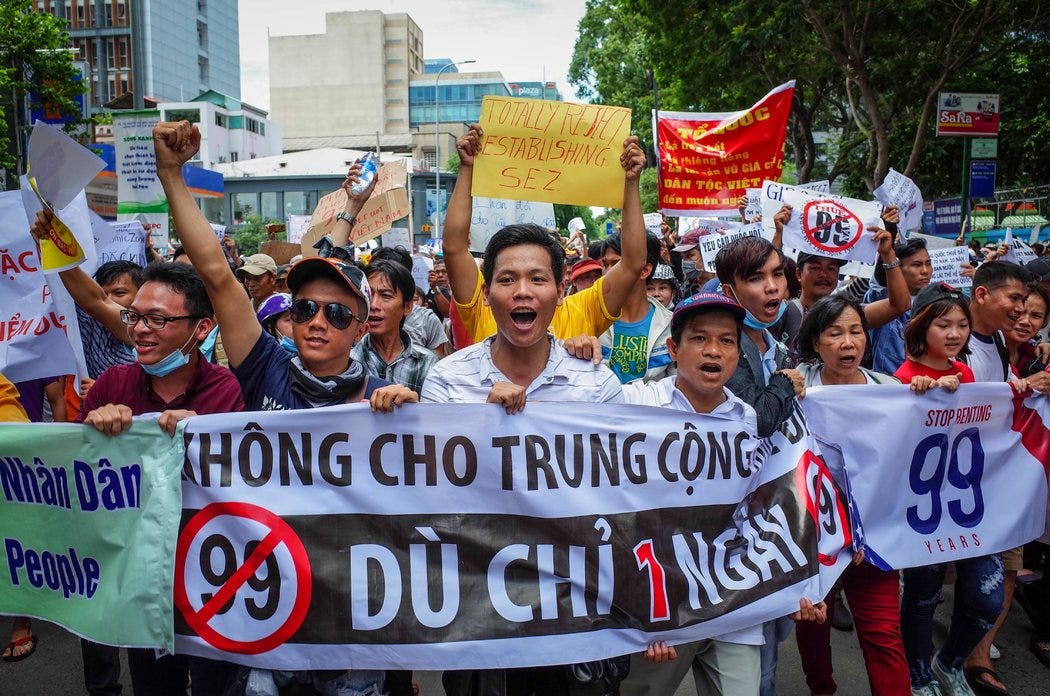
Hanoi’s calculated restraint stems from a precise audit of its own economic ledger. Historically, Vietnam permitted domestic anti-China sentiments to boil over into street riots during past South China Sea crises, only to quickly learn an expensive lesson: the unrest shattered foreign investor confidence, triggered capital flight, and halted manufacturing—inflicting a severe, net-negative blow to its own vulnerable economy. Consequently, Vietnam executed a pragmatic pivot, decoupling its territorial disputes from its broader economic integration with China. Amidst the current global supply chain realignment, Vietnam is aggressively keeping its doors open to absorb manufacturing capital shifting out of China to power its domestic growth. Hanoi is acutely aware that blindly following an escalatory path with any major power is tantamount to economic suicide.
Concurrently, within Singapore’s flawlessly curated multilateral space, this collective restraint and calculation forged the unique, softened atmosphere of the 2026 dialogue.
Conclusion
For years, a pervasive narrative has dominated international strategic circles: that 2027 represents the critical tipping point for a catastrophic conflict in the Taiwan Strait. Yet, if geopolitical tragedies are to manifest in history, their eruption requires the alignment of comprehensive structural conditions—regardless of whether one dreads or anticipates the outcome. They require the continuous, uninterrupted accumulation of hostility and military momentum.
When viewed through this lens of “accumulated momentum,” the events of mid-2026—specifically Donald Trump’s high-profile visit to China and the remarkably stable, low-friction conclusion of the Shangri-La Dialogue—send a distinct signal of de-escalation.
The picture painted by these two events suggests that the primary protagonists, China and the United States, are both willing to pull back on the reins and avoid a premature showdown. With the two giants signaling a mutual desire for a diplomatic plateau, the path forward for secondary players becomes clear: so long as regional actors refrain from manufacturing crises, avoid direct provocations regarding the status of Taiwan, maintain a cap on South China Sea frictions, and provided Washington refrains from crossing red lines via destabilizing arms sales and Tokyo restrains its rhetoric, a planned crisis once thought inevitable in 2027 may well be successfully averted.