

This interview surfaced out of nowhere online and blew up almost instantly. The top comment said, “This is what an interview is supposed to look like.”
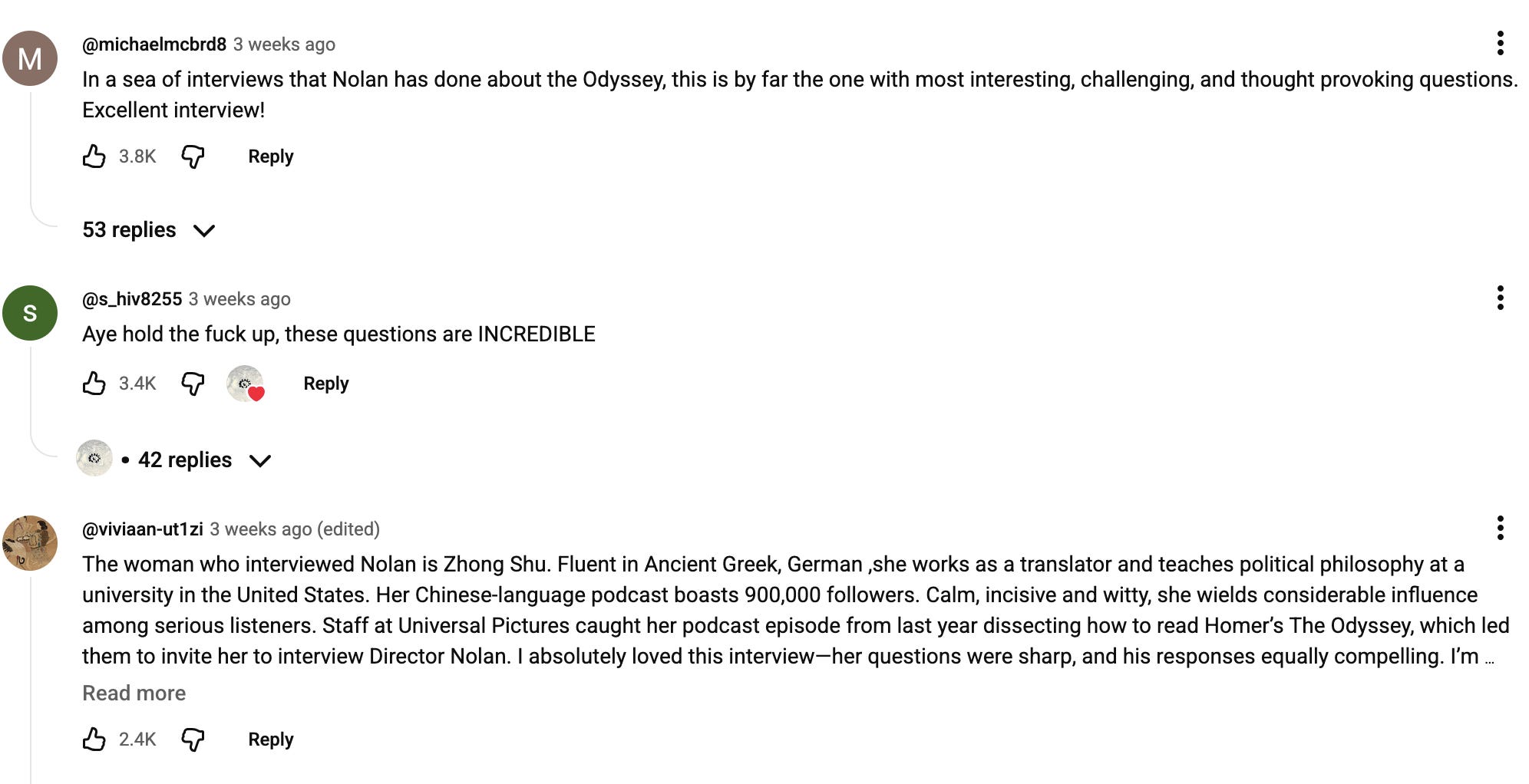
I couldn’t agree more. I caught those few minutes of video right as my summer break was wrapping up. Just two minutes in, I decided to go buy a ticket for the movie. (Honestly, I hadn’t planned on watching it—when a classic text gets a modern makeover, if you don’t think about it too deeply, all the “surprises” end up being entirely predictable.) I managed to catch it just two or three days before it left local theaters. Perhaps under the influence of the interview itself, I found the film surprisingly great.
Back to the interview. I scrolled through the comment section and dug through both English and Chinese online communities, looking for high-quality analysis or deeper extensions of these ideas. I barely found any (not zero, though—I’ll recommend a few later in this series). So, I decided to write down my own thoughts. In my view, anyone who loves Ancient Greece, history, religion, philosophy, or Nolan’s cinema should open up and talk about this. Or at the very least, take a close look at the seven or eight questions Zhong Shu raised in that short 17-minute interview—they are truly important, profound questions.
I don’t want to just repeat what others have already said, though I know that’s almost impossible. So I’ll reframe it: I’ll speak only what I truly believe, and keep it as concise as possible (apologies in advance; I haven’t quite mastered the art of being concise without being boring). That’s all.
Here’s my plan. First, I’m quickly laying out the thoughts that fleeted through my head when I first watched the video and the movie—that’s this piece right here. After this, whenever I have time, I’ll take a deep dive into each of Zhong Shu’s questions one by one and write them up as a series of short, focused essays. Nothing more, nothing less.
So, let’s dive in:
1. All History is Contemporary History
Whether a film respects the original text really doesn’t matter. At a certain point in my life, I came to peace with this idea, and the old adage holds true: all history is contemporary history. History seems to record and describe the past, but how we describe it is entirely dictated by our own era and our current worldview. Expanding on that, every story is worth telling again. What a storyteller chooses to emphasize, what they alter, and what they abandon—comparing those choices is where the real fun begins.
2. The Anti-Hero Trap and the Modern Apology
At some point, every Hollywood hero started wearing the mask of an “anti-hero”. Quentin Tarantino noticed this long ago and seemed to have plenty to say about it, but if you look closely, even Tarantino couldn’t escape that box. Nolan said it in the interview, and he was spot on: just because people can recognize a narrative mechanism doesn’t mean that mechanism stops working. And Zhong Shu was right, too—we are living in an era that demands greatness apologize for itself.
3. A PTSD Veteran in a Modern Christianized World
Odysseus in 2026 looks less like an ancient Greek king and more like a Christianized, PTSD-stricken veteran returning from the Middle East back to America. Sinking into repentance and self-exile over the sack of Troy and the pillaging that violated Zeus’s laws on his journey home—this is precisely how a post-Christian soul is supposed to act.
When it comes to this theme of atonement, Nolan admitted it wasn’t necessarily his conscious intention, but rather the audience projecting modern sensibilities onto the narrative. That leads us straight to a clear conclusion: even if Nolan or the audience ignores or denies it, our modern world remains fundamentally Christianized. To be exact, it is us—products of a modernized Christianity shaped by the Middle Ages, the Renaissance, the Reformation, the Age of Discovery, Puritan migration, colonialism, Nietzsche, Freud, two World Wars, and the Cold War—who project our own psychological needs onto the Homeric age, seeing the exact Odysseus we hope to see.
4. Why Literal Adaptations are Boring
Let me say it again: ignore the purists. The Odyssey isn’t being brought to the screen for the first time. I watched two earlier adaptations years ago, and all I remember today is the vivid visual of the Cyclops being blinded by a sharpened log in his cave. My point is: a lot of people think they want a faithful adaptation, but if you actually gave them something closer to the original text, they’d find it boring and walk away with zero lasting impression.
5. The Source: Eric Cline and the Sea Peoples
Nolan made his creative inspirations crystal clear. As one of the finest storytellers on the planet today, he certainly wasn’t going to settle for a straightforward retelling of Homer. He seems deeply fascinated by Eric Cline’s book, 1177 B.C.: The Year Civilization Collapsed. He incorporated the historical debate surrounding the mysterious “Sea Peoples”—who decimated the Bronze Age civilizations of the Eastern Mediterranean—into the film, creating a brilliant narrative loop: we ourselves are the Sea Peoples. (A theory directly drawn from Cline’s work.)
6. Xenia vs. The Golden Rule
Nolan’s second core focus was Xenia—the sacred law of Zeus regarding guest-friendship. He repeatedly explained this concept during the interview, framing it as an ancient equivalent to the modern “Golden Rule.” What’s fascinating is that the Golden Rule comes straight from the New Testament. Even more interesting: the Golden Rule is something we intuitively get instantly, whereas Xenia, without explicit explanation, might fly right over a modern audience’s head. I asked myself this question: if I hadn’t watched Nolan’s interview, would I have felt that the film’s depiction of Xenia—after stripping away the gods—remained conceptually consistent throughout?
7. The Erasure of Hubris
The most radical change—or rather, deletion—Nolan made to Odysseus was completely stripping away the ancient Greek concept of Hubris (tragic pride). Perhaps he felt it was too difficult to reconcile with the post-Christian modern psyche. But that’s a real shame, because I firmly believe that Hubris is precisely one of the root causes behind so many of the chaotic, terrible things happening in our world right now, in the 21st century—at this very moment. Ah, well. Maybe another great director will feel the need to shoot The Odyssey once more. After all, the gap between the last two major Troy projects wasn’t that long either.
8. A Fully Mapped World: The Death of the Mysterious “Other”
The film sparked plenty of controversy before its release over the casting choices and actors’ skin tones. But after watching it, everyone realized Elon Musk had called it wrong—the director was simply doubling down on the idea that Helen was nothing more than a paper-thin excuse to start the Trojan War.
That said, swapping skin tones or pushing a “diversity” angle in a film—whatever the motivation—often results in a clunky experience. Many people couldn’t quite articulate why it felt off, but I think someone hit the nail right on the head: Johnathan Bi. (I highly recommend checking out his commentary.)
I completely agree with his point: where Nolan’s narrative diverges most fundamentally from Homer’s text is in how it handles the unknown.
In Homer’s worldview, the unknown world was vast, shrouded in fog, brimming with wild imagination, and populated by strange beings whose intentions—friend or foe—were completely uncertain. This sense of boundary defined the journey home as a true epic of exploration and heroism.
However, a thoroughly modernized, diverse crew completely shatters that atmospheric illusion. It constantly yanks the audience back into 2026. And this is the single biggest difference between our 2026 world and Homer’s: our world has no mystery left. We no longer have a genuine, terrifying “Other” whose hostility or friendship remains unknown. We have nowhere left on Earth to truly explore. And naturally, when there is nothing left unknown, there is nothing left to fear or revere.
Let me repeat it again. This isn’t Nolan’s fault. Long before the camera rolled, right from the moment casting began, the artwork had already begun describing its true subject: a portrait of what kind of bizarre creatures we have become, living in an age where the fog of war is lifted, the map is fully revealed, and there is nothing unknown left to fear.