

Noah Smith just published a fascinating piece over at his newsletter:

Reading it made me reflect on a fundamental question: What do all these dark figures and their regimes actually have in common—from 20th-century Fascism and Communism to 21st-century Islamic extremism?
The short answer is false and misguided ideas.
If we brush aside the radical ideologies driving these regimes and ignore what these people truly believed—focusing solely on raw geopolitics, historical grievances, or economic interests—we are missing the elephant in the room and then wondering why the house is a mess. At the end of the day, it is toxic ideas that turn human beings into monsters capable of unleashing havoc on the world.
That thought reminded me of an essay I wrote a while ago. I got caught up with work and missed my original window around the 4th of July, but I figure it’s better late than never. Here it is:
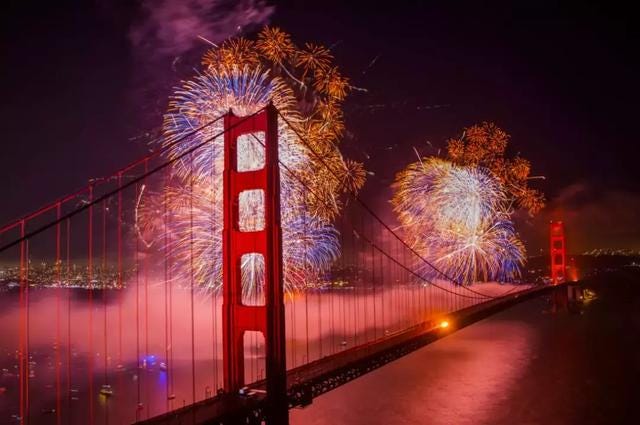
Every 4th of July, as fireworks light up the night sky across America, almost all of those explosives are made in China. In fact, Chinese monks invented them back in the 7th century.
I’ve always found that a bit ironic. But if you really want to gauge how hot or cold the relationship between Washington and Beijing is, don’t look at the fireworks. Look at the birthday cards.
For the past forty years, the diplomatic teletypes sent between these two superpowers on July 4th have been a perfect thermometer for global politics. And right now? That thermometer is reading absolute zero.
I. An Archaeological Dig into Diplomatic Birthday Cards
For two full decades after 1949, the diplomatic channel between Beijing and Washington registered a simple message: “Addressee Unknown.”
Think about it. While the US and the Soviets were locked in Cold War 1.0, their soldiers rarely shot at each other directly. China and America, on the other hand, fought a brutal war in Korea. That blood, combined with the Taiwan issue, completely cut off the diplomatic antenna.
It wasn’t until 1979, when official relations were established, that the two sides started sending greetings again. What followed was a wild ride of changing temperatures.
Look at 1984, the peak of the honeymoon era. The Chinese leadership sent a letter to Ronald Reagan that almost read like a love note:
“On the occasion of the Independence Day of the United States of America, I wish to extend warm congratulations to Your Excellency... Your visit to China has injected fresh momentum into enhancing mutual understanding and trust between our two peoples. A stable Sino-US relationship is a solid bedrock for maintaining world peace.”
Fast forward to 1998, after Bill Clinton visited Beijing. The Chinese message was still visibly warm, talking up a “constructive strategic partnership for the 21st century” that would bring peace and prosperity to the whole world.
Now, compare that to the 2020s.
Today, all the moisture has been completely squeezed out of these greetings. On recent July 4ths, the Chinese Ambassador to the US posts a tweet on X that reads like a cold, sterile press release:
“Best wishes to the American people on Independence Day.”
Notice that? Not a single word about the US government.
And Washington returns the favor. On October 1st, for China’s National Day, the U.S. State Department releases a statement that says, almost word-for-word:
“The United States extends congratulations to the people of China.”
That’s it. The diplomatic birthday cards have been stripped down to a basic insurance policy. The real message between the lines is simple: Happy Birthday. Let’s keep talking so we don’t accidentally start shooting at each other.
II. Cold War Typewriters and Transactional Greetings
To be fair, turning a birthday into cold, transactional office politics wasn’t invented yesterday. The Soviets and Americans turned it into an art form during Cold War 1.0.
Take July 4, 1961. The world was on the edge of the Cuban Missile Crisis. Just a month earlier, John F. Kennedy and Nikita Khrushchev had a brutal, door-slamming showdown in Vienna over Berlin and nuclear weapons.
On July 3rd, Khrushchev sent an Independence Day wire to the White House. The first half was polite. The second half? He slapped the tension right onto the party table. He basically wrote: Happy 185th Anniversary! Now let’s talk about solving the urgent problems we fought about in Vienna before we blow each other up.
Kennedy didn’t back down. Receiving the wire, he fired back a reply loaded with American ideological firepower. He used the occasion to poke Khrushchev right in the eye about individual liberty and freedom—a direct jab at the Soviet Iron Curtain.
Of course, even Cold War 1.0 had thaws. By 1973, after Brezhnev met Richard Nixon at Camp David, the Soviet telegram sounded almost cozy again, praising “healthy, constructive” relations. But those thaws were rare.
III. Are We Already in Cold War 2.0?
When you lay all these historical birthday cards out on the table and watch the prose shrink and freeze, it’s hard to escape a creepy feeling: current relations between Beijing and Washington feel even colder than Moscow and Washington felt back then.
So, are we already living in Cold War 2.0?
I’m not the first to ask this. Historian Niall Ferguson says flat out: Yes, Cold War 2.0 is real. In fact, he argues it’s far more dangerous than the first one because the US and Chinese economies are so deeply intertwined. Decoupling them is like trying to separate Siamese twins with a butcher knife.
Officially, Washington avoids the phrase, preferring terms like “extreme strategic competition.” Officially, Beijing rejects the narrative entirely, accusing the US of a “Cold War mentality.”
Yet, here is the real dissonance: if you sit in on internal lectures hosted by top Chinese think tanks today, scholars openly use Ferguson’s “Cold War 2.0” label with their domestic audiences.
It makes me wonder: Did the ordinary Muscovite standing in a bread line in 1955, or a Texas farmer harvesting corn, actually realize at the time that they were living through something history books would later name “The Cold War”? Probably not. They just lived it.
IV. The Passionate Love Letters of the 1940s
If you want the biggest plot twist of all, you have to dig even further back.
Over the entire 250-year history of the United States, the most passionate, rapturous Independence Day tributes ever written didn’t come from Western allies. They came from the Communist world in the 1940s.
On July 4, 1945, right after victory in Europe, Joseph Stalin sent a wire to Harry Truman praising “the greatest alliance of strength in human history” and celebrating the “magnificent industrial productivity” of America.
But Stalin’s letter was cold compared to what came out of Yan’an.
On July 4, 1944, inside primitive cave dwellings in Shaanxi, the Chinese Communist Party printed an Independence Day editorial in their newspaper, the Jiefang Daily, on coarse, grass paper. It was a poetic love letter to American democracy. It explicitly praised Washington, Jefferson, Lincoln, and Roosevelt, concluding with:
“Long live the Fourth of July! Long live a democratic America!”
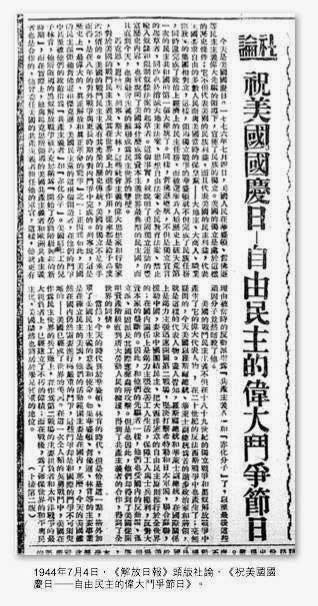
A year earlier, in 1943, their official wartime paper published an essay titled “Ode to Democracy—Dedicated to America’s Independence Day.” For decades, people assumed Mao Zedong wrote it himself. Ironically, it wasn’t until 2020 that official Party historians in Beijing published archival research confirming that Mao didn’t write it.
Still, the words remain on the yellowed paper.
Looking at those passionate love letters from eighty years ago, and comparing them to the one-line tweets of today, you realize how far the pendulum has swung. The birthday cards don’t lie. The world has changed, and the ice isn’t melting anytime soon.
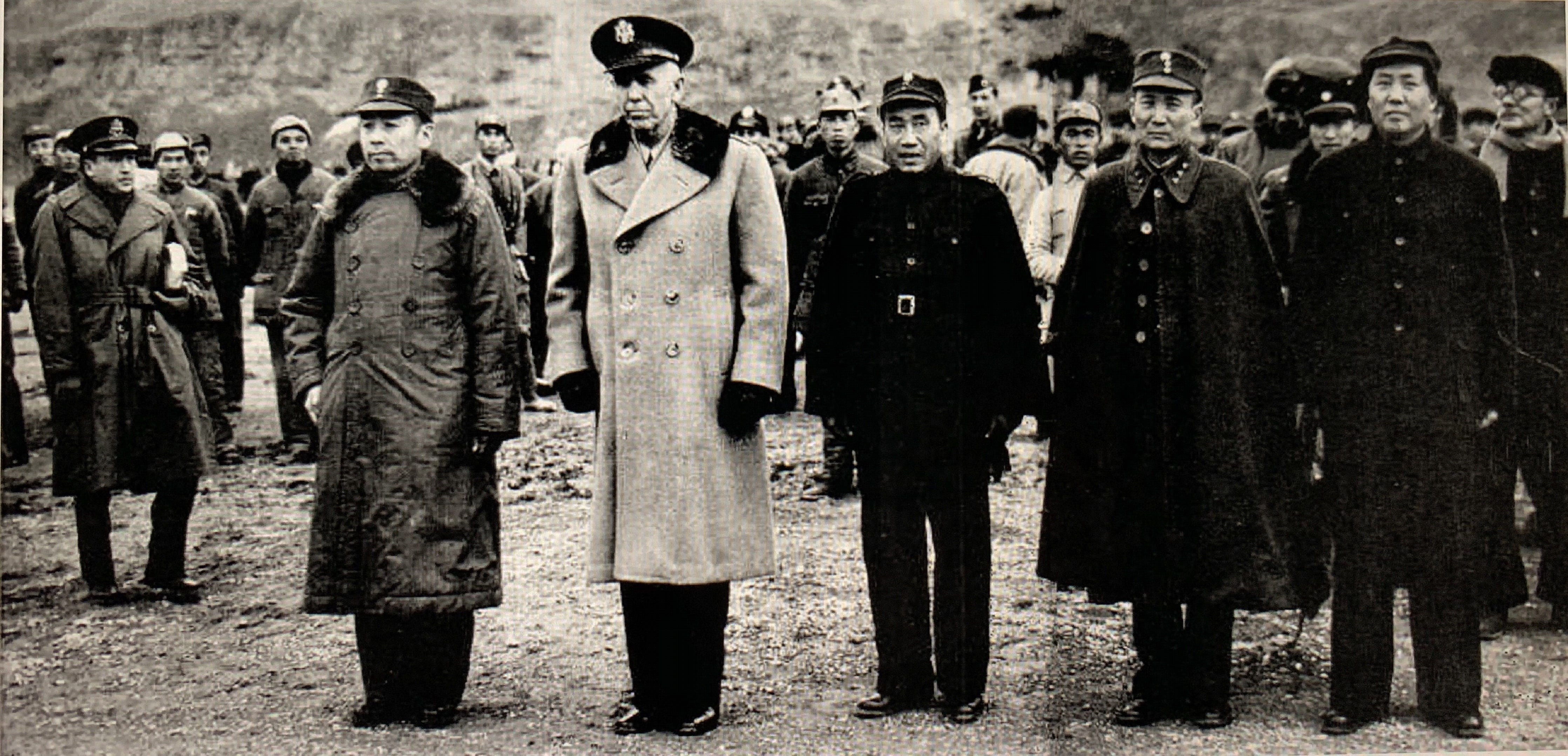
📝 Historical References & Archives:
The 1944 Yan’an Document: Jiefang Daily (Yan’an Edition), July 4, 1944, Page 1 Commentary. National Library of China Microfilm Collection, MF-JFRB-194407.
The 1943 “Ode to Democracy”: Tang Zheng, Chongqing Xinhua Daily, July 4, 1943. Clarified by the Institute of Party History and Literature of the CPC Central Committee (Sept 2020).
1998 Jiang Zemin Telegram: People’s Daily, July 5, 1998, Page 1.
Soviet-American Cables: U.S. Department of State - Office of the Historian: Foreign Relations of the United States (FRUS), 1961–1963, Vol XIV (Berlin Crisis); 1945, Vol V.
Cold War 2.0 Framework: Niall Ferguson, Hoover Institution, Stanford University (Public Commentary 2018–2024).