


The highly anticipated 2026 FIFA World Cup is set to kick off on June 11. As has become the norm, this pinnacle of global football will commence without a single Chinese player on the pitch. There won’t be any Indians either.
But there is a stark difference between the two: Indians genuinely do not care, preferring to reserve their absolute fanaticism for cricket. The Chinese, however, care intensely, deeply, and agonizingly.
A quick glance at the world map reveals a brutal reality for Chinese fans. Because this World Cup is hosted across North America, fans in Beijing face a punishing time-zone inversion. When the likes of Neymar or Mbappé are sprinting across the pitch under the afternoon sun, it is two or three o’clock in the morning in China. This means hundreds of millions of Chinese fans must drag themselves out of bed in the dead of night on regular workdays, navigating their daily lives on pure exhaustion just to watch the tournament unfold.
Yet, the viewership data and sheer passion are staggering.
According to historical official metrics, despite its chronic absence from the tournament, China consistently ranks at the very top tier of global World Cup television viewership, regularly clocking hundreds of millions of unique viewers. During the tournament, the streets of China come alive at midnight—beer flowing, skewers grilling, and countless fans screaming, smashing glasses, and weeping before their screens for foreign teams thousands of miles away. This universal spectating passion, consumer power, and sheer endurance often leave local fans in Europe and South America utterly astonished.
This pervasive national obsession has long birthed a ubiquitous, stinging query across the Chinese internet—one that cuts straight to the quick of national pride: “Out of 1.4 billion people, including 700 million men, how on earth can we not find 11 who know how to play soccer?!”
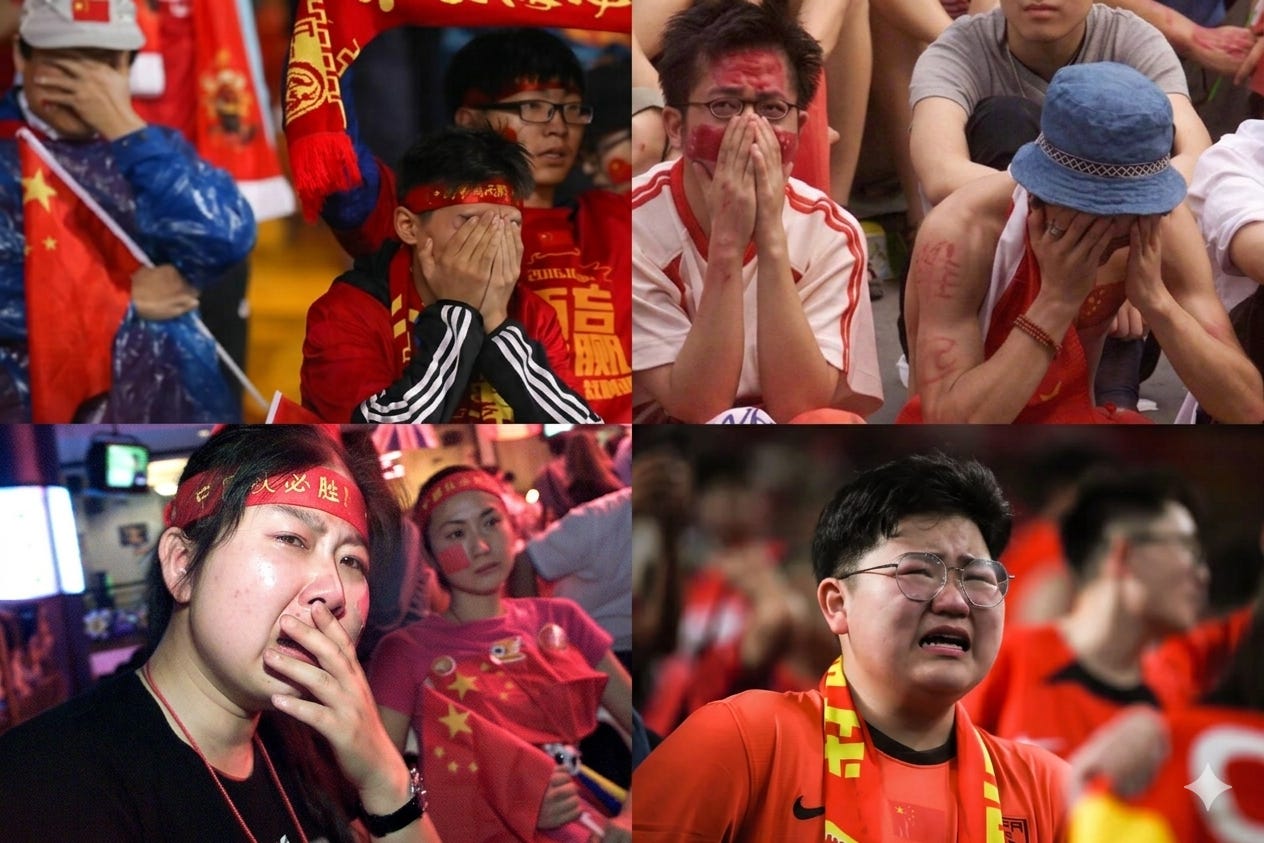
What makes this even more incredible is that China’s emphasis on soccer is written directly into the highest tier of national intent.
This top-level devotion and expectation possess a deep historical lineage. Half a century ago, amidst a nation awaiting rejuvenation, China’s second-generation core leader, Deng Xiaoping—himself an avid football enthusiast—famously declared the slogan that still echoes today: “Soccer must be grasped from the cradle.”
Today, top leader Xi Jinping’s passion for the sport is globally recognized. A true, hardcore fan, he famously articulated “three wishes” for Chinese soccer in an official capacity: for China to host a World Cup, for China to qualify for a World Cup, and for China to win a World Cup.
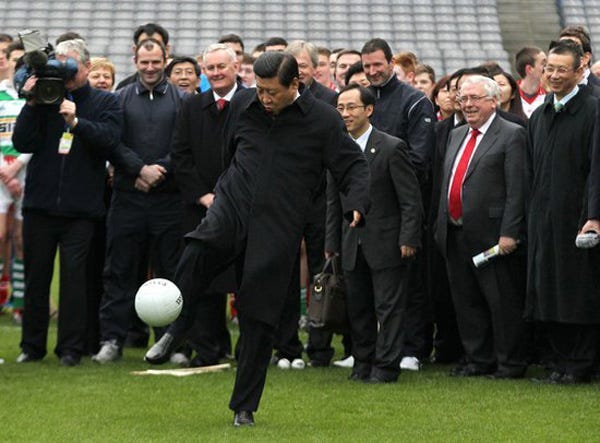
In contemporary discourse, soccer is far more than a mere sport. It has been weaponized with immense political and cultural metaphors—it is viewed as an indispensable, non-negotiable piece of the “Chinese Dream” of great national rejuvenation.
Total Inoculation: A National-Scale Medical Experiment
Given that 1.4 billion people are waiting in anticipation and the highest echelons of leadership are deeply invested, one would assume that under China’s signature system of “concentrating resources to accomplish major undertakings,” miracles would be inevitable. All it should take is money, resources, and policy alignment.
To cure the chronic impotence of Chinese soccer over the past few decades, society has initiated a comprehensive, unrestricted “state-level medical experiment.” Unlike many strategic industries in China that face strict barriers to entry, the state has actively encouraged private capital to intervene in soccer, mobilizing society to a degree that resembles a total national campaign:
First, a total “land, sea, and air” nesting of administrative and social systems.
At the peak, the state-level Chinese Football Association (CFA) and the permanent National Team wield the absolute administrative baton. In the middle, a two-tiered professional league system operates continuously. In sharp contrast to highly restricted sectors, the state has aggressively incentivized private enterprises and tycoons to inject capital into the sport. At the grassroots level, local governments have recently flexed remarkable administrative creativity. In provinces like Guizhou and Jiangsu, locally organized, grass-roots tournaments—such as the wildly popular “Village Super League” (村超 Cunchao)—have been met with widespread acclaim, carving out spectacular grassroots miracles right outside the ruins of the professional leagues. From top to bottom, every system has given soccer a green light.
Second, an absolute carnival of capital and wealth.
Riding the wave of state-backed private intervention, real estate titans, mega state-owned enterprises, and various commercial giants have marched forward in succession. They have continuously funneled astronomical sums of cash into the industry, capturing global attention. At the zenith of the Chinese Super League (CSL), the budget and payroll of a single domestic Chinese club could easily dwarf those of top-tier giants in European second-line leagues.
Third, the wholesale acquisition of elite global intellect.
The CFA and corporate benefactors cut staggering checks that rattled European football, securing the most legendary and expensive coaching brains on earth: Bora Milutinović, Marcello Lippi, José Antonio Camacho, Guus Hiddink, and Rafael Benítez. Not stopping there, Chinese soccer later engaged in the ultimate “shortcut” mode: large-scale naturalization of foreign players. Using pure financial muscle, elite Brazilian forwards like Elkeson and Aloísio—who possessed no Chinese lineage whatsoever—were transformed into national team anchors, holding Chinese passports and singing the Chinese national anthem. It was tantamount to buying a ready-made national team from abroad without altering the native soil.
Fourth, a collective intellectual anxiety and the CFA’s bizarre experiments.
No industry has caused the entire nation more collective angst. Civic think tanks and elite sociologists, like Zheng Yefu, authored books and papers decades ago offering hard-boiled prescriptions: abolish the permanent national team and aggressively champion a market-driven home-and-away league. Meanwhile, millions of netizens moonlighted as armchair tacticians daily. Internally, the CFA, driven by micro-management from leadership, conjured technical anomalies unheard of in international football: for instance, because a certain official fixated on physical stature, the CFA mandated that “goals scored via headers count for two points in the league”; to train the national team for the Olympics, they ordered the Olympic squad to be packaged as a single entity to play in the professional league for points; and to combat match-fixing, the CFA once famously used a deck of playing cards at a press conference to draw lots to determine the league runner-up.
The Bizarre Physical Regression: China is Not Omnipotent
This is the surreal reality of Chinese soccer: The entire society is actively brainstorming, the state is spending lavishly, the top leadership is deeply committed, and every conceivable measure has been exhausted.
Yet, inexplicably, it fails. Not only does it fail, but it deteriorates systematically. It is as infuriating as it is confounding.
When contrasted with any other industry in China, this failure becomes glaringly anomalous. Over the past half-century, virtually every domain China possessed a fierce political will to improve and conquer has overachieved its targets. From hyper-advanced high-speed rail networks to cutting-edge aerospace and quantum computing, China has advanced aggressively. On the Olympic stage, even in niche sports completely devoid of a domestic mass base—such as diving, weightlifting, and badminton—China’s military-style, closed-loop training systems have manufactured “Dream Teams” that leave the rest of the world in despair.
Except for soccer. Here, every remedy has been deployed, only to trigger a catastrophic physical regression.
In the 1980s, the Chinese Men’s National Team, though prone to heartbreaking “black three minutes” collapses in crunch moments, was universally recognized as a formidable, top-tier force in Asia, going toe-to-toe with Japan, South Korea, and West Asian powerhouses. Today, after thirty years of thunderous professional market reforms, trillions of RMB spent, and a carousel of world-class managers, Chinese men’s soccer has not only been left completely in the dust by Japan and South Korea, but it routinely loses to Vietnam, Syria, and Thailand. It has degenerated into a third- or fourth-rate punching bag in Asia.
Seven hundred million Chinese men, alongside trillions in capital, have ultimately collapsed into an inescapable black hole on the pitch.
The Ultimate Sigh
After witnessing decades of monumental turbulence, the vaporization of trillions in capital, and a terminal disease that only worsens with every cure, the collective sentiment of Chinese society has evolved from the fiery rage of yesteryear to a state of profound impotence and numbness. It has ultimately crystallized into a legendary piece of dark humor that has circulated across the Chinese internet for decades—the ultimate national football joke:
A Chinese soccer fan is walking along the beach when he rubs a magic lamp, and a genie pops out.
The genie says, “I can grant you any three wishes.”
The fan says, “My first wish is for world peace and an end to all wars.”
The genie winces, looking troubled, and says, “Oof, that’s incredibly difficult. Geopolitics are too fractured, conflicts are raging across the Middle East and Europe... let’s pivot to something more realistic.”
The fan thinks for a moment and says, “Alright, my second wish is to lower housing prices so that every regular citizen can afford a home, completely erasing the anxiety of the younger generation.”
The genie wipes a cold sweat from his brow and stammers, “That... that involves complex macroeconomics, financial cycles, and municipal land fiscal reliance. That’s actually harder than world peace. Look, how about you give me a simple, highly tangible wish? Perhaps a small national goal?”
The fan slaps his thigh. “Fine! My third wish is for the Chinese Men’s National Soccer Team to qualify for the World Cup and make it to the Round of 16!”
The genie falls into a long, heavy silence, slowly wipes a tear from his eye, pulls out a map of the world, and sighs deeply:
“Alright, kid... let’s bring that world peace map back over here. Let’s talk about that one again...”
China is capable of anything—except soccer.
But why? Why does a state apparatus and collective mobilization mechanism that proves invincible in every other arena completely malfunction when facing a simple, round ball? Why does it instead morph into a toxin that accelerates systemic corruption and technical regression? And what, exactly, did that mysterious political telephone call into the locker room change?
In our next piece, we begin the autopsy.
Click Subscribe below to join the column. As World Cup technical waves intersect with a macro history of a rising superpower, we will take you deep into the hard-core truth behind Chinese soccer. See you next week.