

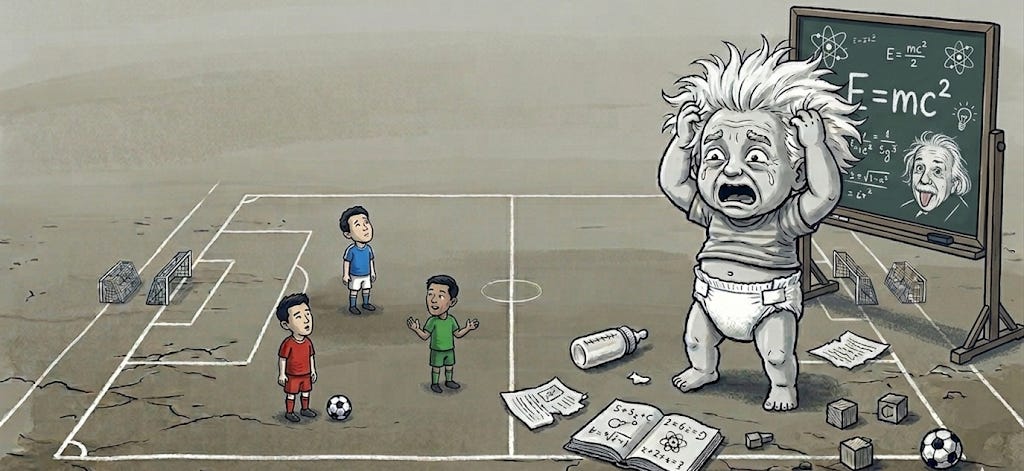
There are, indeed, prophets in this world.
While the classical Chinese Confucian framework never birthed the concept of a divine “prophet” in the strictly monotheistic Western sense, followers of Confucius—the ancient scholar-bureaucrat class and modern intellectual giants—have always inherited the exact same spiritual lineage. They view it as an unalterable moral duty to diagnose societal pathologies, foresee historical trajectories, and speak inconvenient truths to both the ruling apparatus and the public.
Soccer, given its immense political weight on this soil, has degenerated into a systemic institutional disease—one that has tortured the nation for half a century and swallowed colossal fortunes, only to yield a total collapse. So, it’s only natural that the crisis has attracted brilliant minds attempting to diagnose and cure it.

Professor Zheng Yefu, one of the most fiercely independent and critically minded sociologists in the Chinese academic landscape, is precisely such a wise man—a prophet wielding a scalpel.
More than twenty years ago, when the domestic league was still bathed in the shallow euphoria of its infancy and the national team had just made its historic, singular appearance at the 2002 FIFA World Cup, Zheng did something extraordinary. Amidst the deafening nationwide applause, he issued a chillingly clinical diagnostic report on China’s sports and soccer ecosystem. He literally sketched the fatal, underlying pathologies of the sport, line by line, on the blackboard of history.
To dissect the micro-level and market-driven failure of Chinese soccer today, we simply have to trace our analytical insights back to the prophetic framework Zheng established decades ago.
ACT I: THE PROPHET’S BLACKBOARD—FOUR CHILLING DIAGNOSES
In Zheng’s sociological dissection, the desertification of Chinese soccer has never been a consequence of “poor physical genetics” or a “native lack of passion for the sport.” That’s just an excuse. The reality is a logical monstrosity born from a deep, systematic collusion between executive authority and market participants.
His core diagnosis can be distilled into four theoretical artillery shells that continue to echo today:
1. The “Crowding-Out Effect” of the State-Run Apparatus
Zheng pointed out that soccer possesses a fundamentally different genetic code than individual sports like table tennis or gymnastics. The latter can successfully harvest gold medals within a “meticulously controlled greenhouse”—a closed-door, heavily state-funded elite academy system. Soccer, by stark contrast, is a decentralized art form that demands a vast social foundation and organic, bottom-up cultivation.
But here’s the problem: the semi-bureaucratic state apparatus insists on monopolizing all core elements: pitch approvals, coaching certifications, and match hosting rights. This heavy-handed approach exerts a catastrophic “crowding-out effect” on all spontaneous, civilian-led sports organizations. It systematically crushes the organic connection between soccer and community life.
And this explains why China can never cultivate that wild, vibrant “street soccer” soil we see in Brazil or Argentina. A child either pays an exorbitant premium to enter a state-sanctioned academy or is locked out of the game entirely.
2. The “Semi-Market, Semi-Bureaucratic” Hybrid
The professional reforms initiated in 1994 were, in Zheng’s eyes, a complete illusion. They never established genuine modern corporate structures, evolving instead into what can only be described as a warped “rent-seeking club.”
Within this institutional framework, administrative bodies like the Football Association wield absolute life-and-death power over league mechanics, promotion, relegation, and transfer permits. Meanwhile, corporate sponsors are expected to function as endless liquidity taps to placate that power.
Think about it: while authentic professional clubs rely on matchday revenue, broadcasting rights, and commercial merchandising to survive, Chinese clubs were designed as an “appendage economy.” They have neither the iron discipline of a pure state-run system nor the sacred contractual integrity of a free market—they are stuck in the worst of both worlds.
3. The Micro-Level “Utilitarian Ledger”
Analyzing social stratification and household risk management, Zheng posed a heartbreakingly pragmatic question: Why does a rational Chinese parent steadfastly refuse to let their child play soccer?
In Europe or Japan, professional sports operate alongside a distributed risk-mitigation system. If a teenager is cut from a professional academy at age eighteen, they can smoothly pivot back into a mature network of community athletics or university sports. Their athletic talent still guarantees a college degree and a baseline of societal survival.
But in China? Because soccer is entirely decoupled from the fundamental educational system, it becomes a brutal, zero-sum gamble. The failure rate is astronomical, and the downside is absolute zero. If a child fails to turn professional, their complete detachment from academic training leaves them facing an economic abyss.
4. The Absurd Culmination of Rational Behavior
Driven by this rational terror of a zero-downside outcome, over 90% of ordinary families do the math on their financial calculators and make the most logical defensive choice available: they drag their children off the pitches and push them into the hyper-competitive gauntlet of academic tutoring and the college entrance exam (Gaokao).
The parents are perfectly rational. The clubs are perfectly rational. The local bureaucrats are perfectly rational. This is exactly where the ultimate tragedy of Chinese soccer lies: every single participant makes the smartest, most calculating decision at the micro-level, yet their collective sanity colludes to engineer a macro-level desert where absolutely nothing can grow.
ACT II: THE PROPHET’S DUET—THE SCHOLAR DEPARTS, THE SCRIPT REMAINS
The recurring tragedy of a prophet is that he leaves the answer right there on the blackboard, yet the elephant in the room chooses to blindfold itself, executing the exact same fatal dance steps into the abyss.
When Zheng published his original diagnoses, Dalian Wanda FC was his sole anatomical specimen. The real estate tycoon Wang Jianlin had leaned into the grand narrative of the city’s mayor, transforming soccer into Dalian’s ultimate “corporate business card.” Wanda poured reckless amounts of capital into the club, securing a legendary 55-match unbeaten streak.
But let’s look closer, as Zheng astutely observed, this mania was governed by a cold ledger. This was never sports capitalism; it was a “political gift” presented to the highest regional authority in exchange for massive government dividends: land permits, tax exemptions, and state-backed bank credit lines. Unsurprisingly, years later, when the political landscape shifted, the illusion vanished within months, and Wang cut his losses and exited.
The underlying pathology runs so deep that within this specific institutional magnetic field, even after the alarm bells have been rung, successive capitalists seeking to scale their empires will instinctively, uncontrollably slide down the exact same track of political rent-seeking.
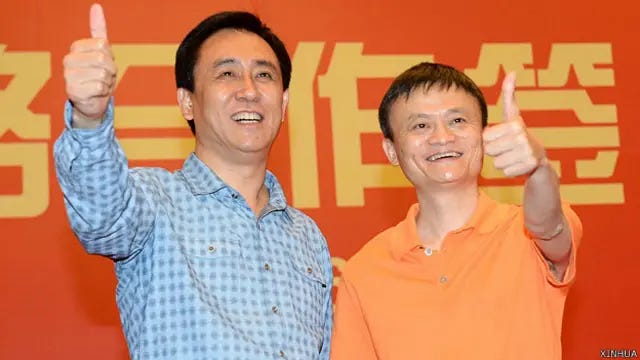
When Zheng formulated his theories, Guangzhou Evergrande did not even exist. Yet twenty years later, Xu Jiayin burst onto the scene, running the exact same script to its absolute financial limits. Multi-million-dollar foreign signings, sky-high domestic salaries, continental championships, and forced naturalization of foreign players—the “Evergrande Dynasty” that infatuated millions of fans was anchored to a ledger far more cynical than Wanda’s.
In the era of hyper-leveraged shadow banking, Evergrande Soccer was never a solvent business; it was simply the ultimate “credit magnifier” and “political pledge” for a massive real estate Ponzi scheme. Xu needed soccer as a massive visibility shield and an un-rejectable display of political alignment to rapidly acquire vast land reserves from municipal governments across the country. The one or two billion yuan the soccer club bled annually was merely a negligible “public relations friction cost” compared to the ocean of liquidity it unlocked from state banks.
History doesn’t bother to invent new stories; it merely rhymes in despair.
When the macroeconomic narrative of the real estate sector fractured in the 2020s and the financial chains snapped, the gold-plated soap bubble of Chinese soccer burst instantly, leaving a wasteland of unpaid wages and institutional wreckage. Wang Jianlin’s quiet retreat preceded Xu Jiayin’s formal arrest. Separated by two decades, two generations of real estate titans completed the perfect empirical validation of Zheng Yefu’s prophecy.
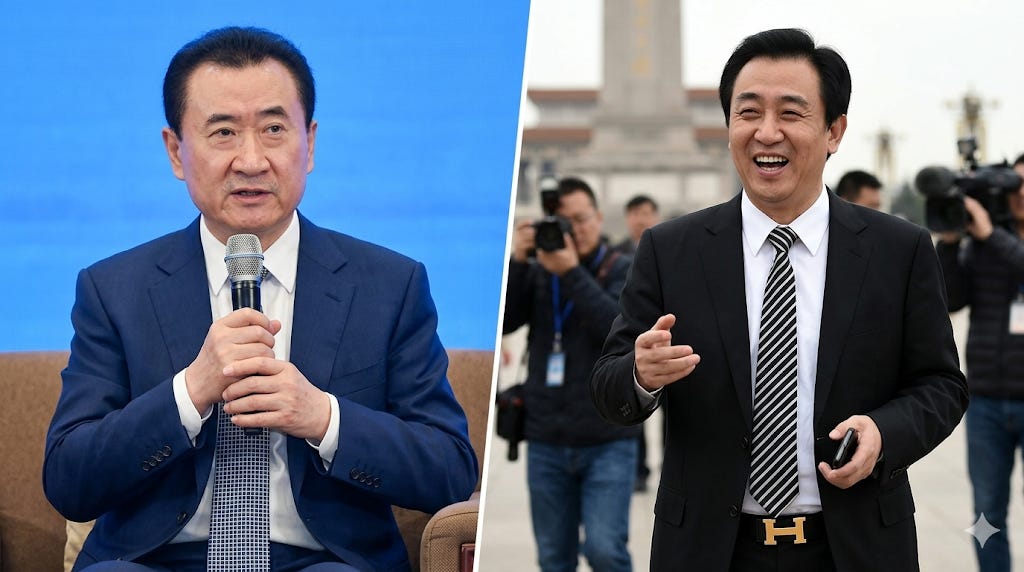
Note: Both Wang Jianlin and Xu Jiayin once stood as the wealthiest men in China. In subsequent chapters of this series, we will dedicate a full installment to the jaw-dropping story of these real estate titans dancing with absolute power. Stay tuned and subscribe.
ACT III: THE GRAND SUBLIMATION—ANATOMY OF A PITCH, PATHOLOGY OF A SYSTEM
Let’s forget about soccer for a moment. If we look past the soccer pitch and examine the broader macro-landscape of modern China, a sobering question emerges: Is this public disaster truly just an isolated sporting anomaly?
Of course not. What lies beneath the laboratory floodlights is actually a high-purity specimen of the master code governing China’s economy and social architecture.
If you get why Chinese soccer is a desert, you get the underlying logic of the structural gridlocks confronting the entire Chinese nation over the last four decades.
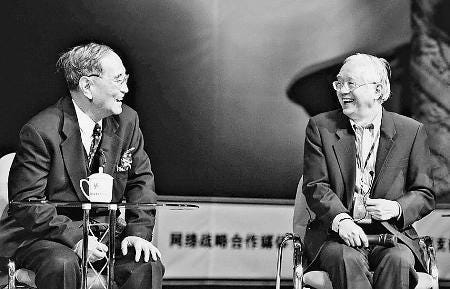
Ever since the pioneering economists of the older generation championed the “dual-track system” (双轨制) during the dawn of Reform and Opening Up, a “semi-market, semi-bureaucratic” hybrid has served as the core engine of Chinese development. Emerging from a Soviet-style command economy, China faced an unprecedented transitional hazard. To avert catastrophic social instability, the dual-track system allowed state-planned quotas and free-market forces to coexist temporarily.
As history has shown, this deeply Eastern policy of compromise was actually infinitely wiser than the “Shock Therapy” designed by Harvard economist Jeffrey Sachs for post-Soviet Russia. Sachs’s radical, overnight liberalization shattered Russia’s institutional guardrails, leading to economic collapse, hyperinflation, and the unchecked rise of lawless oligarchs.
Yet, long after its historical mission was accomplished, the dual-track legacy left a chronic, deeply entrenched side-effect in China: a structural addiction to the semi-market, semi-bureaucratic hybrid.
Under this enduring dualistic (二元) structure, the ruling apparatus craves the immense efficiency, wealth generation, and innovative vitality of a free market, yet harbors a deep-seated, systemic fear of any spontaneous order that operates outside its administrative sightline. Consequently, administrative power retains absolute control over the master valves of production—chiefly land allocation, policy approvals, and market access.
For a private entrepreneur, the most rational survival calculation is never to invest in long-term, fundamental research and development, because true innovation demands an environment of durable property rights and predictable, blind rules. In a crucible where regulations can be rewritten overnight by a bureaucratic decree, the ultimate strategy for survival and scaling will always be to court power, mirror power, and appease power to secure short-term resources.
This hybrid abnormality inevitably manufactures a hyper-leveraged “mirage of prosperity.” But the moment the macroeconomic tides recede, the illusion vanishes, revealing an economy devoid of globally competitive core technologies and lacking a sustainable foundation—suffocated by misallocated capital and institutional rent-seeking.
At the micro-level, this exact dualistic trap invades the defensive psychology of ordinary households.
The reason no parent will let their child play soccer—because the downside of failing outside the system is zero—is exactly why the entire society is locked in a desperate, suffocating race for civil service exams (公务员考试) and academic over-testing. The state concentrates its premium healthcare, education, and pension resources within the walls of the establishment (体制内).
To step outside this fortress and eschew the grueling path of conventional academic compliance means forfeiting any fundamental social safety net. If an individual fails in the unshielded private arena or gets caught in a sudden regulatory correction, their downside, too, is absolute zero.
This institutional zero-sum game forces the country’s brightest young minds into the cubicles of bureaucratic test-taking. It drains the entire society of its raw, creative risk-taking spirit and baseline spontaneity—the exact same creative spontaneity that has been systematically squeezed out of every imaginative young boy on the soccer pitch.
The harsh reality is this: The more absolute control the administrative apparatus demands over a complex ecosystem dependent on spontaneous order, trust, and creative flair, the faster that ecosystem dies.
Epilogue: The Silence of the Wasteland
The risk-mitigation of parents, the political compliance of capitalists, and the KPI-driven overcorrections of bureaucrats intertwine flawlessly within the warmth of this semi-market, semi-bureaucratic incubator. Every calculating actor performs their role with immaculate precision, and together, they co-conspire to convert this vast territory into a silent, frozen desert.
[End of Part III]
A Note to the Faithful
If you have watched this unfold, you already know the deep, almost inescapable despair that defines Chinese soccer today. Is this desert truly beyond redemption?
In the short term, the reality is just plain brutal. A bitter consensus is already freezing over the culture: unless FIFA drastically inflates the World Cup field by more than double its current size, fans over forty will likely never see their national team step onto a World Cup pitch again in their lifetimes.
Yet, if you look toward a more distant horizon, history hints at a different echo. In the early 1980s, when China looked at its lagging computers, advanced technology, and athletics, Deng Xiaoping frequently rallied the nation with a simple phrase: “Start them from the cradle.”
The philosophy here is a profoundly Eastern, generational relay. But to put it in a metaphor far more familiar to the Western mind: it is an acceptance of the “Fate of Moses.” It is the sobering realization that our generation is bound to serve merely as the road-pavers, destined to perish in the wilderness without ever crossing the Jordan River into the Promised Land. We make this long-term sacrifice so that the children might one day inherit the dream.
Yes, a flicker of redemption remains. In the final installment of this series, New Hope, we will map out the only viable cure left for this seemingly terminal patient.
But before we get there, we have to confront an immediate, equally absurd crisis shaking the current cultural landscape. Believe it or not, hundreds of millions of China’s most fanatic fans came perilously close to being completely blacked out from watching this very World Cup.
In our next chapter, we peel back the curtain on the high-stakes, nerve-wracking chess match over broadcasting rights—a dispute that lays bare the shifting economic realities of a changing superpower. Stay tuned.
📝 Historical References and Sources
Zheng Yefu’s Sociological Diagnoses: Core theoretical concepts adapted from Professor Zheng Yefu’s extensive sociological treatises on the state-run sports apparatus, the distortions of China’s market-oriented athletic reforms, and the risk structures governing contemporary social mobility.
Corporate and Municipal Archives of Dalian Wanda & Guangzhou Evergrande: Drawn from Wang Jianlin’s early public addresses, Dalian municipal urban planning logs designating soccer as a civic trademark, and the annual financial audits of Guangzhou Evergrande FC (during its listing on the National Equities Exchange and Quotations), which document the correlation between club liabilities and national land acquisition profiles.
The Dual-Track System vs. Shock Therapy: Grounded in Wu Jinglian’s Understanding China’s Economic Reform, alongside comparative macroeconomic analyses of Jeffrey Sachs’s structural adjustment programs in the early 1990s Russian Federation.