

The Eleventh-Hour Buzzer Beater
In mid-May 2026, a bizarre little drama unfolded on the runway at Beijing Capital International Airport.
Air Force One had just taken off, carrying Donald Trump away after a high-stakes state visit that left diplomats on both sides frantically recalculating the geopolitical balance. Moments later, a quiet private jet touched down on the very same tarmac. Out stepped Mattias Grafström, the Secretary General of FIFA.
He arrived on a desperate, last-minute rescue mission: to beg Beijing for a TV deal for the North American World Cup.
For months, the mood between China Media Group (CMG)—the state broadcasting giant at No. 11 Fuxing Road—and FIFA headquarters in Zurich had been completely frozen. FIFA originally demanded an astronomical $250 million to $300 million for the broadcast rights. Their logic? Hey, we expanded the tournament to 48 teams! There are 104 matches now instead of 64! More games, higher price. Pay up.
Except, this time, Beijing didn’t play along.
Chinese negotiators basically threw their cards on the table and said: “If the price isn’t right, we’re totally fine with a historic blackout. We just won’t air it.”
By mid-May, with the tournament weeks away, state TV schedules across China still didn’t mention a single World Cup match. That “total blackout” threat triggered absolute panic among FIFA’s top corporate sponsors. Losing access to 1.4 billion people meant their multi-million-dollar ad campaigns were about to crash and burn.
So Grafström flew to Beijing, ate humble pie, and caved.
The final price tag? Around $60 million.
That’s an 80% discount off FIFA’s original asking price. On paper, it looks like a textbook victory in hardball negotiation. But if you look back four or eight years at how lavishly China used to spend on global sports, this slashed price tag tells a much bigger story. It’s a surgical knife cutting open the massive shifts in China’s economy, its geopolitical mood, and the public psyche.
Where Did the Private Cash Go?
To understand why CMG was suddenly acting so stingy, you have to look at how generous they used to be.
For the 2018 World Cup in Russia and 2022 in Qatar, CMG paid roughly $150 million per tournament. Global observers marveled at Chinese buying power. But here’s the open secret: CMG didn’t actually foot that bill alone. They had a flock of cash-flush tech giants backing them up.
CMG acted as the ultimate monopoly landlord:
In 2018, deep-pocketed video streaming platforms spent hundreds of millions of RMB buying digital sub-licensing rights from CMG.
In 2022, short-video giants stepped up and paid absurd sums for streaming rights.
CMG nominally paid $150 million, but the moment they resold the digital rights, they instantly recouped their costs and walked away with hundreds of millions in pure profit. It was a sweet deal.
Fast forward to 2026, and that easy tech money has completely dried up.
The era of wild, burn-money-for-traffic growth in China’s tech sector is officially dead. The universal corporate motto now is “cost-cutting and efficiency.” No internet executive in their right mind is going to drop tens of millions of dollars on a one-month sporting event just to get temporary traffic.
Then you have the nightmare time difference. Matches in North America air in China between 1:00 AM and 6:00 AM. That’s an absolute dead zone for advertisers. Who pays premium ad rates when the entire country is asleep?
Without private tech cash to absorb the risk, and with ad revenues looking bleak, CMG was facing massive financial losses if it paid peak prices. So they played their strongest hand: cold, hard economic reality. No buyers, tight budgets, price goes down.
The Geopolitical Thermometer
There’s another rule in global sports politics: how much a country is willing to overpay for broadcast rights is directly tied to its geopolitical relationship with the host nation.
Look back at Russia in 2018 and Qatar in 2022. Both were top-tier diplomatic allies of Beijing. Dropping huge money on those tournaments wasn’t just about sports; it was a geopolitical statement. It aligned with energy deals and grand diplomacy. Spending big was part of showing off “superpower stature.”
Now look at 2026. The hosts were the US, Canada, and Mexico.
Against the backdrop of a prolonged tech cold war and endless strategic friction with Washington, why would Beijing use state money to subsidize a massive sports spectacle hosted primarily by America? There was zero geopolitical incentive.
Playing hardball and threatening a blackout wasn’t just a business tactic; it was a subtle, unscripted diplomatic gesture. The geopolitical temperature cooled down, so the era of paying a premium for “vanity projects” expired.
“Tightening Belts” and the Ultimate Monopoly
While the macro economy shifted, a big change in domestic “political correctness” gave CMG the ultimate leverage to walk away.
A few years ago, during the height of China’s “Gold Rush Soccer” craze, spending big money on sports was encouraged top-down. State media happily threw money around to fulfill those grand narratives.
Today? The primary political mandate across China is “tightening our belts”, cutting financial risk, and clamping down on waste. With local government budgets tight, handing over hundreds of millions of precious foreign exchange dollars to a Swiss-based sports cartel would have been a massive political liability.
Framing the negotiation as “defending public coffers against foreign corporate extortion” wasn’t just safe inside the bureaucracy—it made CMG look like heroes to the public.
And the public’s reaction was fascinating.
In the past, missing a World Cup would have sparked outrage among fans. This time, as the blackout loomed, the public was shockingly pragmatic. Two feelings merged:
Pure disgust with the Chinese Men’s National Team: Even though FIFA expanded the World Cup to 48 teams, China’s national team—constantly losing and rocked by massive anti-corruption purges—didn’t even come close to qualifying. Fans were blunt: If our own team isn’t playing, why use taxpayer money to enrich FIFA?
A refusal to be ripped off: When news broke about how cheap FIFA sold rights in other countries compared to what they demanded from China, fans rallied behind the TV network: “If they try to overcharge us, just walk away.”
Backed by official austerity directives and a unified public, CMG sat comfortably in this game of chicken. Plus, thanks to state regulations, CMG is the only legal entity allowed to buy World Cup rights in China. FIFA had literally no other buyers. Faced with an impenetrable wall of administrative monopoly, FIFA had no choice but to fold.
Epilogue: Cheap Spectators and Genuine Hope
This wild game of chicken ended in a clever compromise.
$60 million. Not too high, not too low.
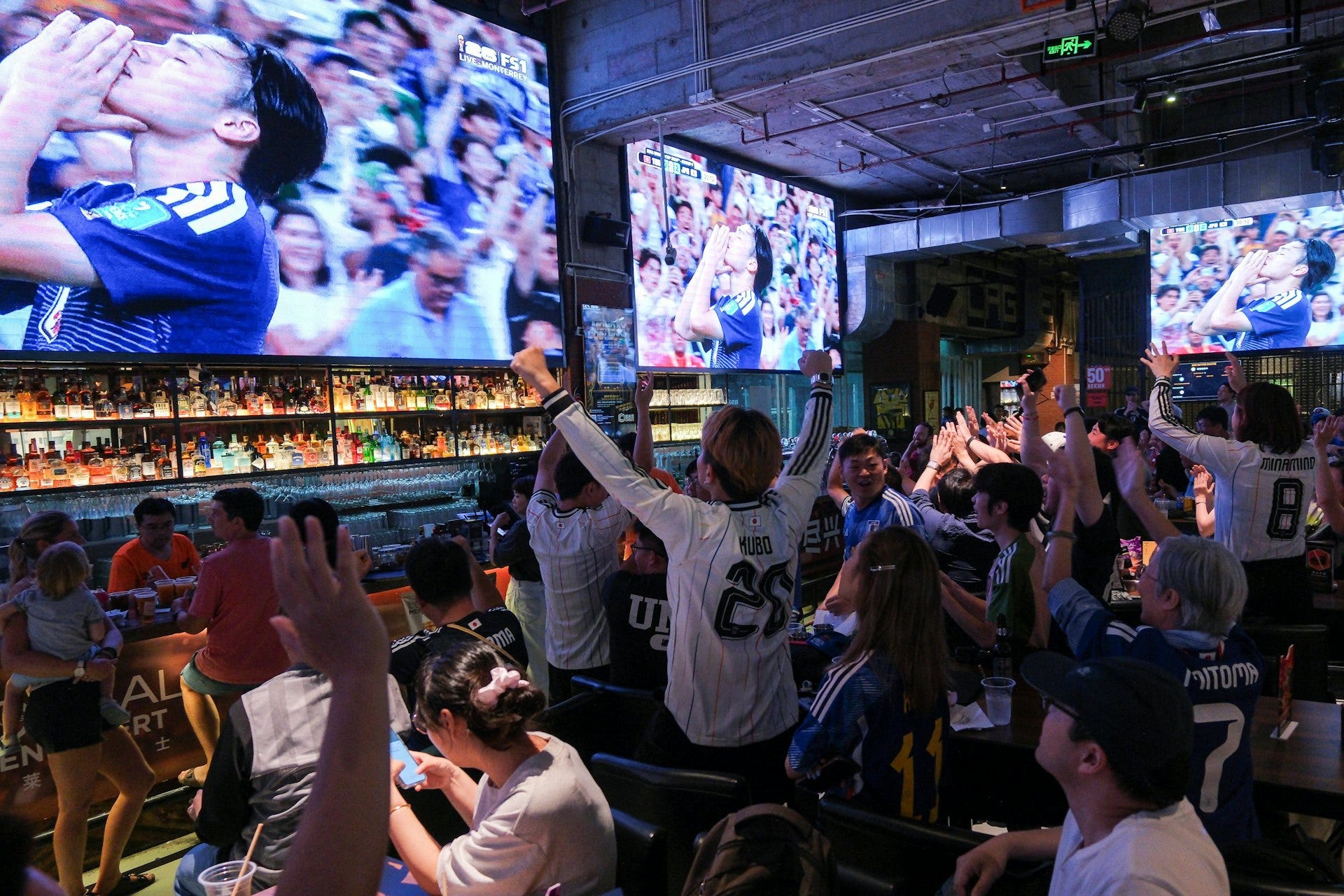
It was just enough to preserve the summer ritual for millions of fans—drinking beer, eating skewers, and watching football late at night to blow off steam during an economic transition. At the same time, it delivered a win for state-mandated fiscal discipline.
The days of Chinese corporations acting as FIFA’s ultimate cash cows are gone, too. In Qatar, Chinese sponsors dropped nearly $1.4 billion, topping global leaderboards. For this 2026 tournament, that corporate roster collapsed, leaving behind only a few old faces with global supply chains.
The dive from $150 million to $60 million shows that grand sports diplomacy has officially given way to cold, hard economic logic.
Even more interesting? Along with this $60 million deal, CMG quietly locked in an extended broadcast contract running all the way to 2031.
Because of FIFA’s continental rotation rules, China is structurally barred from hosting a World Cup anytime soon anyway. This long-term TV contract signals a quiet, long-term decision from the top: For the next decade, we aren’t bidding, we aren’t spending crazy money, and we aren’t overpaying. We’re just going to sit back and be cheap spectators.
The noisy dream of hosting a World Cup has been quietly locked away in a drawer.
Yet, here’s the ultimate irony of history: now that the bloated money is gone, the vanity projects are dead, and the grand narratives have crumbled into a cold $60 million compromise... the tiny, fragile seeds of real Chinese football might finally have room to grow in the quiet, neglected mud at the grassroots.
Author’s Note: This piece was drafted roughly two months ago, prior to the kickoff of the 2026 World Cup. Now that the tournament has concluded, publishing this analysis might seem belated at first glance. However, looking back at how the broadcast unfolded and how Chinese viewership played out, every economic and geopolitical thesis laid out here holds entirely true. The $60 million compromise wasn’t just a temporary negotiation trick; it marked a permanent structural pivot in how China interacts with global sports monopolies. We release it today as an unedited historical audit of that transition.