

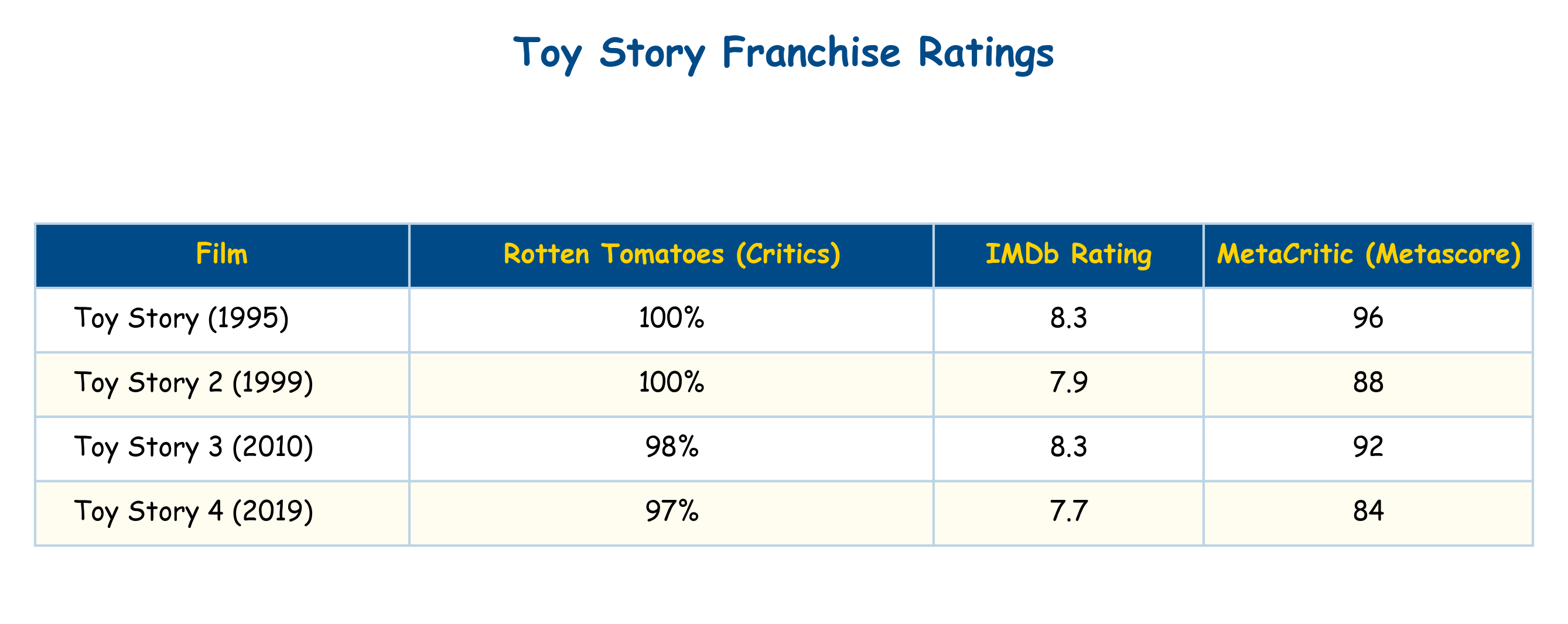
In the endless discourse surrounding Pixar’s legacy, Toy Story 4 occupies a uniquely awkward space. If you look closely at the data across the big three review platforms, its audience reception sits at a distinct historical trough for the franchise:
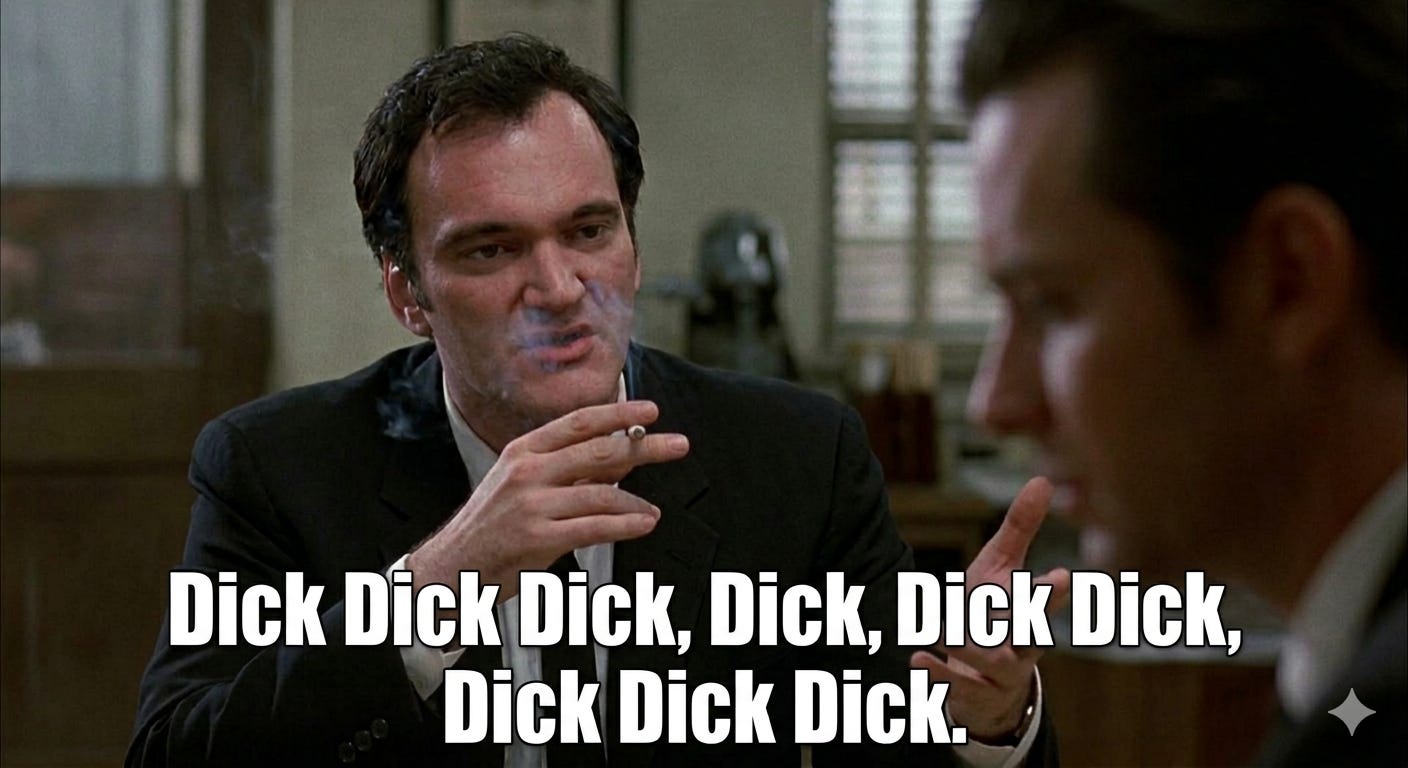
Even a director as sharp and brilliant as Quentin Tarantino openly dismissed it, declaring that the original trilogy completed a perfect, airtight narrative arc, rendering the fourth installment a fundamentally redundant piece of cinematic baggage.
I love Tarantino. He is piercingly wise, and I agree with about 99% of what comes out of his mouth. But I also know that at his core, he will always be a boy living inside a cinematic wonderland—and nobody on earth is better at high-art bullshit than him:
His stance, however, is profoundly representative. It speaks for a massive collective of “grown-up boys” in the audience who desperately cling to the nursery-room greenhouse of the third film, demanding that the story stop because it felt “complete.”
But was it really complete? Andy grew up and left. Does Woody, as a living, breathing soul with an internal consciousness, have to be buried alive on the altar of someone else’s childhood closure?
The reason so many people recoil from the fourth chapter is that they are entirely unequipped to look directly into the suffocating, unvarnished loneliness that defines Woody’s existence.
Years ago, when I first watched Toy Story 4 in a theater, I walked out into the street feeling a profound, unsettling sense of friction. The texture of this film was vastly different from its predecessors. It was a bit cold.
And that chill sets in from the very opening sequence. Ever since that relentless storm years ago when Bo Peep was packed into a car and driven away, Woody stood in the torrential rain, and a piece of his soul died right there on the asphalt. For the long years that followed, he returned to the bedroom, flawlessly executing his role as the venerable general and the perfect leader. Yet, he was essentially operating on a ghost script.
In the first half of the film, long before his path crosses with Bo again, Woody’s inner landscape is a silent, sprawling wasteland.
I will never forget the sequence where he walks alongside Forky down that endless, dark highway. There is no joy here; there is no lighthearted, swashbuckling heroism. The moonlight stretches their shadows into thin, brittle lines. The air in that frame is heavy with an emotion exclusive to a certain stage of adulthood—the quiet desperation of dragging your feet mechanically forward simply because you are bound to a legacy, a duty, an established identity. You cannot halt your momentum, because you are Woody. Everyone leans on you. But deep within the marrow of your bones, there is an unnamable irritation, a profound hollowness.
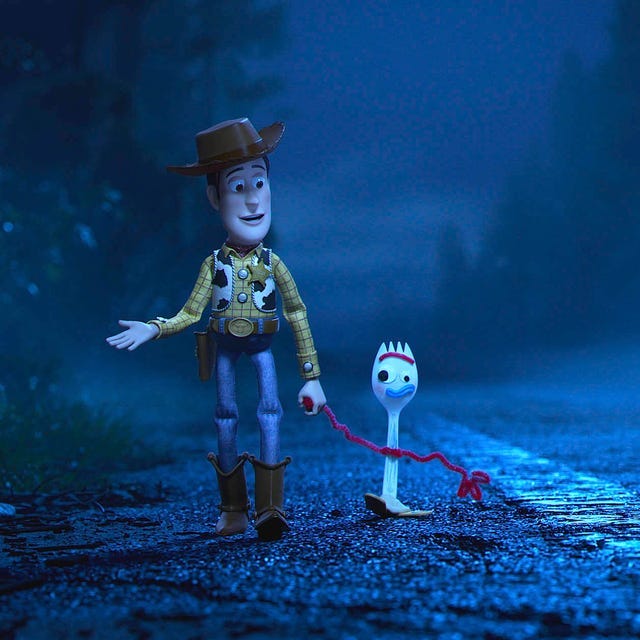
At one point on that road, he accidentally speaks the name “Andy.” It is a shattering, micro-historical detail. His GOD is gone. His foundational universe has collapsed into rubble. He is merely riding the inertia of being a “useful tool,” using the high-minded morphine of responsibility to numb the pain of his displacement.
In every chapter prior, Woody was omnipotent. He was the ultimate friend, the flawless architect of order, keeping everyone safe and whole. And everyone around him grew—Andy crossed the threshold into manhood, Buzz Lightyear parsed the world for what it was and retained his optimistic love for the toy box. But the premium Woody paid for this stability was absolute: he chained himself permanently to the pedestal of his own martyrdom.
But what about Woody’s own evolution?
Toy Story 4 is fundamentally about Woody’s growth—the most unexpected, radical, and soul-baring transformation of his entire existence.
When he confronts Gabby Gabby, the broken doll who has twisted into a paranoid, ruthless antagonist because she believes her defective voice box is the sole reason she is unloved, Woody makes a choice that left legions of fanboys feeling deeply frustrated and confused:
“Take it.”
He literally surrenders his internal voice box to his enemy. This isn’t merely a tactical transaction to salvage Forky. It is an act of high-dimensional transcendence. Woody has lived long enough to enjoy the full, unadulterated devotion of two generations of children; his spiritual ledger is rich. He looks at this broken creature and recognizes that her malice is merely the desperate defense mechanism of a soul that has never experienced love.
He sacrifices his own core mechanical heart to exorcise her demons. It is an act of supreme, almost biblical mercy. Yet, watching it unfold on screen, my heart ached for him.
He has given everything. He has endured the deepest, quietest isolation. He has distributed all his love to the collective. Does he not, as an independent agent, deserve a shot at a higher form of happiness?
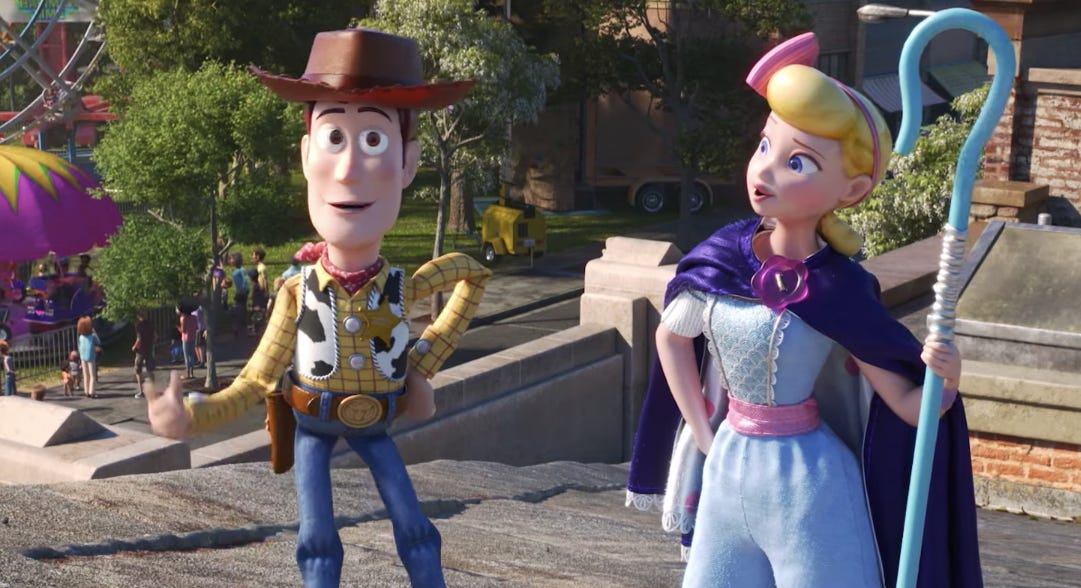
The paradigm shifts entirely when Bo Peep takes Woody to the absolute summit of the carousel, overlooking the carnival grounds.
It is here that we see Bo Peep’s incredible growth. She is no longer the fragile figurine who once needed Woody’s protection. Her years on the road have made her deeply confident and independent. You see, Woody and Bo, they are worthy of each other and they belong together.
From that vantage point, Woody is suddenly exposed to a sprawling, wild, entirely emancipated world of infinite scale. Bo looks at this cowboy, who is still desperately clinging to the memory of a closet door and a little girl named Bonnie who doesn’t even notice his absence, and delivers a line that shatters his entire theological framework:
“Open your eyes, Woody... Sometimes change can be good!”
Woody flinches. He continues to struggle, attempting to draw circles in the dirt with the chains of his old institutional loyalty. So Bo looks him straight in the eyes and delivers the absolute coup de grâce to his old worldview:
“I’m not the one that’s lost.”
The boys in the audience mistakenly believed that Bo Peep—undomesticated, fractured, wandering the open road without a master—was the “Lost Toy.” But a mature man watching that scene will feel a sudden, visceral tremor. Because the creature who has locked himself inside the living room of a child who will never love a cowboy doll for long, the one marching mechanically through the dark on pure memory, refusing to open his eyes to the horizon—that is the man who is truly lost in the ruins of a dead faith.
Let’s be real: Bonnie was never going to love a cowboy doll for long.
Thankfully, Buzz Lightyear is there. A true brother is someone who walks the long miles with you, and at the ultimate crossroads, sees through your internal gridlock and gives you the definitive push toward your own salvation.
In that singular moment, the idol shatters, and a living, breathing individual worthy of happiness is born.
Years have passed, and as I have grown into a more mature man, I revisited Toy Story 4 alone in the dead of night. Suddenly, I understood its immense, staggering genius. Every frame, every line of dialogue, every heavy breath on screen clicked into sharp focus.
Every single Toy Story film is a flawless masterpiece, and Part 4 is no exception.
The franchise has never been a series of simple adventure stories tailored for children, and Toy Story 4 is certainly not one. It is Pixar’s definitive cautionary tale sent to the good men of this world—those who have filled their entire lives with history, duty, and sacrifice, only to find themselves swallowed whole by an unnamable, vacant isolation when their immediate task is done.
It tells us that life is terrifyingly long. It warns us never to go gently into that empty, post-duty void. Even if you are deep into the autumn of your years, you still possess the sovereign right to chase your own meaning. There are still three things entirely worth opening your eyes for:
To witness the scale of a wild, wide, and significantly bigger world out there;
To strip away the calcified dogmas of past responsibilities and aggressively pursue your personal freedom;
And, finally, to reclaim your first love.
To those who saw themselves in Woody's journey: may you find the courage to believe that your sovereign right to chase freedom remains entirely intact.
If you still hold a grudge against Toy Story 4, I understand. To all the big boys out there who are still enjoying the reckless, beautiful luxury of youth—go ahead and enjoy it. You’ve earned it.
But mark my words: when you are finally worn smooth by the friction of existence, when you have buckled under the raw weight of real-world duty, and you find yourself standing face-to-face with absolute silence in the middle of the night—go back and watch Toy Story 4 again. You will weep. Because that film isn’t a cash-grab sequel. It is a love letter that Pixar mailed ahead of time, waiting for the man you are destined to become.
One more thing.
Hold on. Isn’t this Substack supposed to be an analytical ledger dedicated to dissecting macroeconomic realities, geopolitical friction, and the micro-institutions of contemporary China? Why on earth are we spending thousands of words unpacking an American animated feature about plastic toys?
Does it feel like an erratic detour? It isn’t. The analytical and narrative connective tissue here is completely absolute.
Think about it for a moment. Close your eyes and ask yourself: what is the one asset that the United States possesses that China, to this very day, lacks entirely? Take a few seconds before you formulate an answer.
Is it deep tech? Artificial Intelligence? High-end NVIDIA silicon? Reusable rocket arrays? Carrier strike groups? Next-generation stealth airframes? Strategic nuclear deterrence?
You are looking at the wrong ledger. Every single one of those hard-power metrics is something China either already possesses, is rapidly closing the gap on, or will inevitably manufacture. But if you look at what a four-year-old child and an eighty-year-old elder are watching on cinema screens in China (and let’s be thoroughly honest—adults in China do not have a genuine cultural habit of consuming domestic animation), oh gosh, you will instantly realize what America’s truest, most irreplaceable asset is.
It is precisely this: the Toy Story epic. Within every single frame of its rendering, inside every second of its dialogue, it is aggressively building, repairing, and reconstructing the fragile scaffolding of the American Spirit—an asset that is perhaps deeply fracturing in the mundane, hyper-polarized reality of daily American life, but remains entirely un-copyable across the Pacific.
(And if you are curious about the institutional history, the constraints, and the economic landscape of Chinese animation arts, stay tuned. We will be mapping that exact, highly neglected territory through the lens of institutional economics in future dispatches.)
Oh, one more thing (no, seriously, the actual last thing)...
From a certain macroscopic perspective, Tarantino might actually be right.
We all love Toy Story. Who doesn’t? By any standard metric of myth-making, the smart play was to take the win, quit while you’re ahead, and leave Part 3 as an untouched monument in cinematic history. To push past that horizon and drop a fourth film into the world was a stupendous administrative risk, and a borderline offensive transgression against the fans.
Yet, as I have laid out, if we are to be intellectually honest, Toy Story 4 achieved a flawless score. It broke the mold to expand Woody’s soul. It made the entire universe richer.
But now, my friends, Toy Story 5 is looming on the immediate horizon, set to debut this June.
And to be perfectly frank, I am sitting here with a knot in my stomach far tighter than the one Tarantino had in 2019. On the eve of its premiere, I might actually say a quiet prayer: Please, God, don’t let them butcher this. Pixar has, well, certainly fumbled a few things in their recent portfolio. But I have to assume they understand that the Toy Story franchise is the one sacred vault they cannot afford to vandalize.
Because if they actually manage to botch this one, do you understand what that signal means?
It means we will have to look at the ledger and mournfully concede a tragic reality: that a small, uninspired cabal of mercenary corporatists has finally succeeded in killing the final, hopeful reservoir of the American Spirit—a rare, uniquely independent ethos capable of healing the partisan divide, which Woody and Tom Hanks spent decades curating for the world.
So, that being said, if Hollywood compromises this legacy, the cultural signal of American exhaustion broadcast to global theaters will run deeper than any political turbulence could ever inflict. It would stand as a permanent artifact of a decaying national imagination.
But until the house lights dim, we can only watch, wait, and hope.