

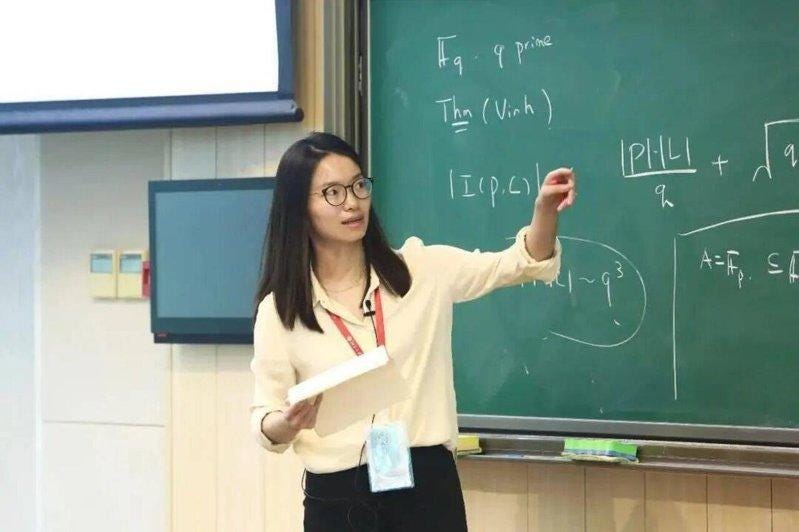
In July 2026, the eyes of both academia and quantitative finance are locked onto the opening of the International Congress of Mathematicians (ICM). As of today, prediction markets like Polymarket show the betting odds for Chinese mathematician Hong Wang winning the 2026 Fields Medal soaring at a staggering 90%. In a discipline as ruthlessly meritocratic and peer-review-driven as mathematics, a gap like that means the market and the academic establishment are betting heavily on a historic certainty.
For non-expert readers, two structural constraints of this prize are worth keeping in mind. First, the Fields Medal is the undisputed Nobel Prize of mathematics. Alfred Nobel omitted the field from his will for deeply personal and historical reasons, leaving the Fields Medal as the absolute apex of the discipline. It is also far more unforgiving than the Nobel: awarded only once every four years, it enforces a strict age limit of under 40. Second, if the shoe drops tomorrow, Wang will become the first-ever Fields Medalist whose primary intellectual foundation was fully engineered within mainland China. Previous ethnic Chinese winners, such as Shing-Tung Yau and Terence Tao, had profound overseas academic incubation. Wang’s core foundation, by contrast, was entirely home-grown.
This isn’t just about the coronation of an individual genius. It gives us a rare, pristine lens to audit China’s baseline educational machine, its state-directed scientific strategies, and the global circulation of Chinese intellectual capital.
The Deterministic Signals: Peer Backing and the “Bellwether” Prize Chain
Why is the market willing to open a commanding 83% win probability on the eve of the official announcement? It boils down to a sequence of undeniable, hard academic facts.
The definitive breakthrough arrived in February 2025. Wang and her co-author published a massive 127-page paper on arXiv, delivering a complete proof of the Kakeya Conjecture in 3D—a geometric riddle that had stymied the mathematical world for over a century.
To grasp the magnitude of this feat, the problem can be stripped down to a basic question of geometric logic. Postulated by Japanese mathematician Soichi Kakeya in 1917, the conjecture asks how a needle can be rotated 360 degrees within an arbitrarily small spatial volume. While the problem is well-understood in two dimensions, the third dimension introduces a chaotic geometric pathology that had long blocked progress in harmonic analysis and partial differential equations.
Terence Tao, widely considered the smartest and most versatile living mathematician on the planet, spent years digging into this exact domain. He yielded monumental partial results, but ultimately hit a wall at three dimensions. Today, it is Tao himself who has been broadcasting Wang’s definitive proof to the world, praising it as a “spectacular development in geometric measure theory.” In a field where elite peer review dictates everything, this level of backing from the absolute ceiling of the discipline effectively seals the verdict on Wang’s caliber.
Here’s an ironic, yet telling truth: before Terence Tao praised her breakthrough, almost nobody in China knew who Hong Wang was. This severe information asymmetry mirrors the exact dynamic of DeepSeek. Before it blindsided Silicon Valley, virtually no one in the broader Chinese public had heard of Liang Wenfeng (Note: we will soon publish a dedicated deep-dive into Liang, a mathematician-turned-founder who utilized elite quantitative frameworks to disrupt the tech landscape, effectively operating as a Chinese iteration of Jim Simons).
Wang’s rise through the global academic hierarchy leaves a unmistakable paper trail of bellwether awards:
2022: The Maryam Mirzakhani New Frontiers Prize. 2025: The Gold Medal of the International Congress of Chinese Mathematicians (ICCM). Late 2025: The prestigious Salem Prize. Historical data demonstrates that due to its fiercely selective criteria, the conversion rate from a Salem Prize to a Fields Medal is exceptionally high. April 2026: A consecutive sweep of both the Clay Research Award and the New Horizons in Mathematics Prize.
This institutional stacking of awards tells you everything you need to know. The inner sanctum of global mathematics had reached a quiet consensus on Wang long before the ballots for tomorrow were even cast.
Who is Hong Wang? A Cold Audit of a Globalized Academic Elite
When you strip away the romanticized tropes of child prodigies favored by mainstream media, Wang’s trajectory reveals a precise and calculated globalized blueprint.
Born in Guilin, China, in 1991, she entered Peking University in 2007 at the age of 16. What’s fascinating here is that she didn’t even start in the math department; she was initially enrolled in the School of Earth and Space Sciences. A year later, driven by pure personal agency and a real appetite for logic, she cleared the institutional hurdles to transfer into the elite School of Mathematical Sciences. That single detail demolishes the lazy narrative that top Asian mathematicians are just robotic byproducts force-fed by a rigid state machine. She chose this path herself.
After securing her foundational toolkit at Peking University, Wang integrated seamlessly into the highest echelon of international academic circulation. She went first to Paris—the spiritual capital of mathematics. Immersed at the École Polytechnique and Paris-Sud University, she absorbed the high-intensity, Bourbaki-style tradition of French mathematics, which prioritizes radical abstraction, structural elegance, and ironclad rigor.
From there, she crossed the Atlantic to pursue her PhD at MIT under Larry Guth, a master of harmonic analysis. At the blackboards of MIT, she synthesized the abstract structuralism of the French school with the aggressive, “strip-the-problem-bare” intuition that defines elite American research. Today, she holds tenured positions at both NYU’s Courant Institute and the IHES in France.
From the karst mountains of Guilin to Peking University, and through the cafes of Paris to the labs of Boston, Wang’s journey tracks perfectly along the most energetic nodes of global mathematics. Her career proves a clear thesis: the Chinese domestic system builds an incredibly resilient foundation, but it takes international institutional circulation to deliver the final, master-level architecture.
The Structural Implications: Why This Matters for Educational History
If Wang claims the medal tomorrow, her victory will deliver the first hard-data refutation of a long-standing critique regarding Chinese education.
For decades, the debate surrounding China’s K-12 and undergraduate pipeline has been starkly polarized. Critics argue that an obsessive reliance on high-pressure rote learning, test-taking, and aggressive drilling permanently damages an individual’s capacity for original imagination. The systemic byproduct, the theory goes, is a massive army of highly competent “advanced engineers” or “algorithmic cogs,” but an absolute vacuum when it comes to the rare, paradigm-shifting thinkers capable of winning Nobels or Fields Medals.
Yet, Wang’s cognitive muscle was entirely forged within this exact domestic infrastructure. If she crosses the finish line tomorrow, the “creativity curse” narrative gets blown apart by a statistical outlier of the highest order. It will prove that rigorous logical drilling—even within a high-stakes testing culture—isn’t inherently fatal to world-class creativity. The heavy STEM apparatus of the Chinese system does possess the baseline probability required to output supreme scientific innovators.
Conclusion: Maintaining a Measured Silence on the Horizon
The 2026 Fields Medal ceremony will officially take place on July 23 during the International Congress of Mathematicians (ICM) in Philadelphia, USA. However, according to a provisional schedule code prematurely exposed on the official ICM website, the four winners of this edition appear to be Yu Deng, Hong Wang (both alumni of Peking University), John Pardon, and Jacob Tsimerman. If this leak holds true, it will mark a historic watershed: the first time Chinese mathematicians have secured top honors in the very same cohort.
On the immediate eve of this milestone, we choose to maintain a measured silence, refraining from any premature celebration untethered to confirmed facts.
Still, whatever happens tomorrow is merely the opening salvo in a much larger macroeconomic and cultural story. Capitalizing on this moment, this column will roll out an intensive series of deep-dives over the coming days. Moving beyond individual genius, we will dissect the underlying forces governing Chinese macro-strategy, social policies, and global technopolitics. We will confront the unvarnished struggles and historical paradoxes that define this era:
Why are the Chinese culturally stereotyped as uniquely formidable at mathematics? Why did the early Chinese state explicitly categorize mathematics as the “nuclear weapon of the poor” during its mid-century modernization push? Has this half-century-old strategic emphasis succeeded, or has it devolved into a hyper-competitive, rote-learning trap? We will trace the evolution of this policy alongside shifting social expectations.
The divergence of genius and the battle between open and closed paradigms. How far can an insulated, purely domestic testing ecosystem push a human brain’s raw processing power? Why is a domestic foundation merely the baseline, while the frictionless velocity of international academic circulation remains the non-negotiable “last 1%” required to build a master? We will audit the parallel paths of China’s most elite minds.
The spillover of institutional inertia and the Chinese spine of the AI revolution. How has this societal obsession with mathematics bled into highly concentrated diaspora networks, producing elite young talent overseas capable of rivaling the mainland’s best? More critically, as the global economy enters the capital-intensive bottleneck of the AI revolution, how is this massive pool of elite mathematical talent quietly reshaping the underlying architecture of global technology?
Hit the Subscribe button below to lock in your access. The moment the results are made official tomorrow, we will deliver the sharpest, most analytical breakdown on the web. Stay tuned.