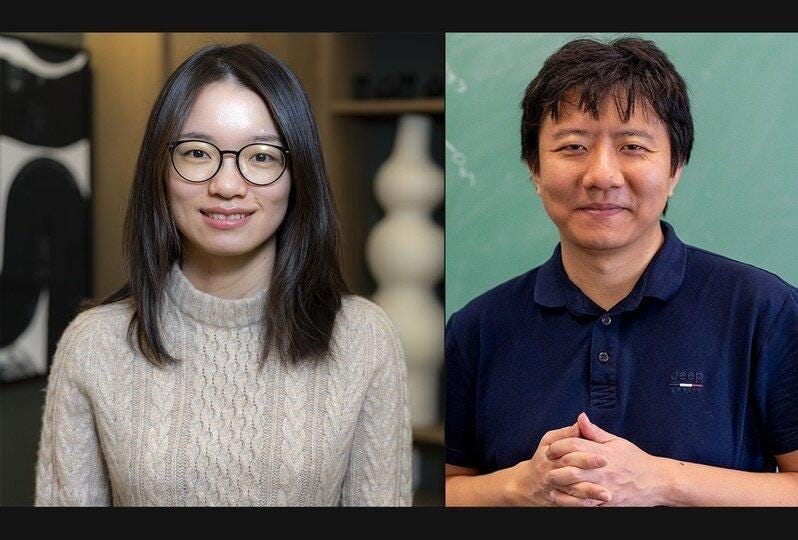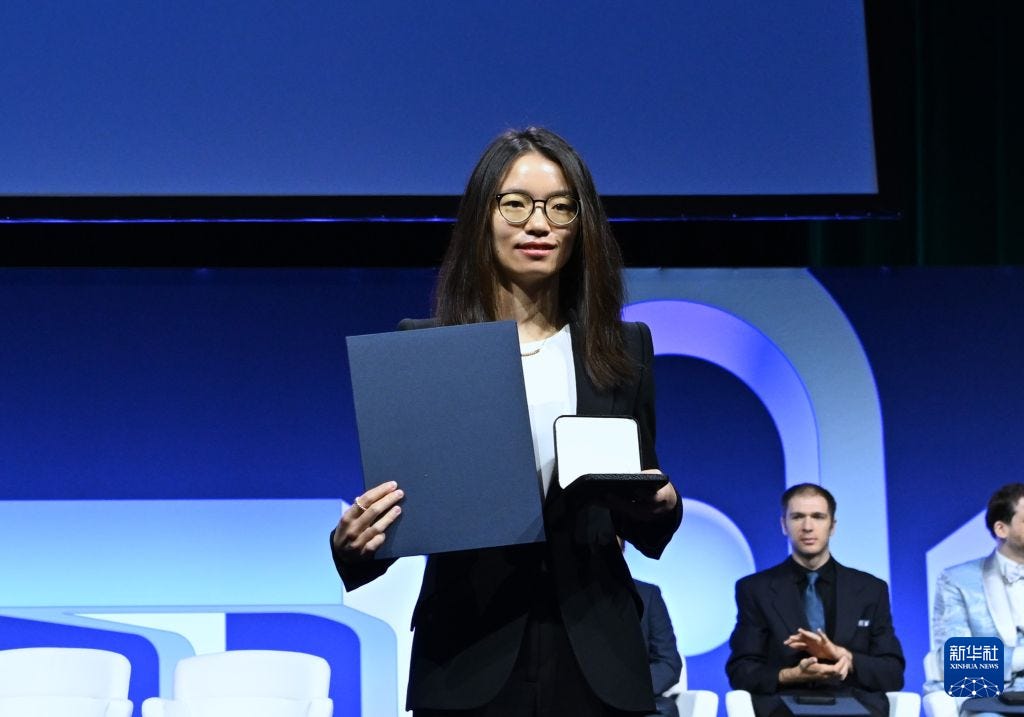
On July 23, 2026, breaking news finally hit the floor at the International Congress of Mathematicians: Hong Wang, a 35-year-old mathematician from NYU and the IHES in France, officially won the Fields Medal.
If you follow prediction markets, this wasn’t exactly a plot twist. Betting odds on platforms like Polymarket had been hovering near 90% for months. In a world as ruthlessly objective as mathematics, everyone saw it coming.
Yet, when the official announcement dropped, my feed completely blew up.
To understand why people are losing their minds over this, you have to realize that the Fields Medal isn’t just the math equivalent of a Nobel Prize—it’s actually much more brutal. You only get one shot every four years, and if you turn 40 before you pull off a groundbreaking proof, you’re permanently out of the game. You miss the window, you’re done.
But Wang’s victory isn’t just about an individual genius getting her crown. It matters because she just single-handedly shattered a century-old curse that has haunted Chinese education for generations.
Wang is the very first Fields Medalist whose entire baseline mathematical education was built inside mainland China. Previous winners of Chinese descent—like Shing-Tung Yau or Terence Tao—were raised in Hong Kong or Australia, thriving within open Western academic systems. Wang, by contrast, grew up in the karst mountains of Guilin, went to a local high school, and got her bachelor’s degree at Peking University.
Her win isn’t just a proud moment for her. It’s a cold, hard piece of data that forces us to re-examine the entire Chinese educational machine.
The “Qian Xuesen Question” and the Ghost in the Machine
To understand the curse Wang just broke, you have to know about the famous “Qian Xuesen Question.”
Back in 2005, Qian Xuesen—the legendary rocket scientist who studied at Caltech, helped build America’s early missile defense, and later returned home to lay the groundwork for China’s modern aerospace program—asked a haunting question on his deathbed:
“Why do our schools always fail to produce top-tier, creative talents?”
That single sentence hit the Chinese academic world like a freight train. Coming from the ultimate architect of the country’s state-led scientific apparatus, it felt like a tragic confession. Over the next two decades, his question ossified into a national anxiety. Every time Nobel or Fields Medal season rolled around, people would bring up Qian’s ghost to explain why China kept coming up empty.
And the critique always sounded the same: the Chinese system is great at mass-producing exam-taking robots, but it permanently crushes the spark of wild, original imagination needed for high-level innovation.
Look at the numbers, and it’s hard to argue with that logic.
At the high school level, Chinese kids dominate international math olympiads and destroy PISA rankings. At the undergraduate level, students from elite schools like Peking University have raw calculation speed and technical toolkits that make Western professors salivate.
And then... they hit a wall.
Once these prodigies enter graduate school or research careers, that terrifying advantage vanishes. Most of them blend seamlessly into the middle of the bell curve—becoming senior coders in Silicon Valley, quant traders on Wall Street, or solid academic workers grinding out incremental papers on roadmaps drawn by someone else.
It led to a famous, deeply depressing theory floated by Tsinghua economist Qian Yingyi: Chinese education has a high average, but low standards.
It raises the floor for millions, turning out competent engineers to power a massive industrial economy. But it does so by running a steamroller over individual quirks. The prevailing consensus was clear: If you spend your formative years inside this pressure-cooker system, your brain gets formatted. You can become a flawless cog, but you’ll never become a master who creates a new field.
Until today, nobody could disprove that theory. Hong Wang just did.
She didn’t grow up in an elite overseas salon. She sat in a regular classroom in Guilin, took the high-stress exams, and survived the Peking University math department. Yet, her creative capacity didn’t get steamrolled. She used that rock-solid foundation to crack a 3D geometric puzzle that had stumped the world’s best minds for a century.
Why Math? The “Poor Man’s Nuclear Weapon”
Why did this breakthrough happen in pure mathematics, rather than experimental physics or bio-tech?
To answer that, you have to look back at a desperate geopolitical decision made seventy years ago.
In the mid-20th century, a impoverished China faced a tight Western embargo and had zero industrial capital. Building high-tech physics labs cost hundreds of millions of dollars that the state simply didn’t have. So, strategic planners came up with a desperate shortcut: they branded mathematics as “the poor man’s nuclear weapon.”
Math doesn’t require multi-million-dollar particle accelerators or imported Western equipment. It requires a desk, a pen, a stack of paper, and raw gray matter. Under a dim kerosene lamp, a young mind in rural China could theoretically go toe-to-toe with a professor at Princeton on a completely equal playing field.
That strategy created two wildly different historical paths for Chinese math talent.
The first path was the closed, domestic loop. Think of Chen Jingrun, who famously worked on Goldbach’s Conjecture in the 1970s. Chen sat on a broken wooden bedboard in a tiny, unheated room, burning through sacks of scratch paper to deliver a world-class proof. But his story is ultimately a heartbreaking tragedy. Malnourished, physically broken, and completely isolated from global academic exchanges, he never produced another major breakthrough and died young. His life proved that grit alone inside a closed box eventually drains a genius dry.
The second path was the open, global circulation. Look at Yitang Zhang. After leaving China, Zhang spent years struggling on the margins of American academia, even working at a Subway counter to pay rent. Yet, because he was inside an open environment that granted him total personal freedom, he pulled off a jaw-dropping proof on prime numbers in his late fifties, driven purely by personal obsession.
The lesson for policymakers is brutal: Math might be the “poor man’s nuclear weapon,” but isolating your geniuses inside a closed system is a dead end.
A Tale of Two Geniuses: The Lone Ranger vs. The Global Nomad
To really see why Hong Wang won today, you have to contrast her with another legend of her generation: Wei Dongyi.
If you spend any time on Chinese social media, you’ve heard of “God Wei.” Born in the same year as Wang (1991), Wei achieved mythical status by scoring back-to-back perfect scores at the International Mathematical Olympiad in 2008 and 2009.
Today, the Chinese internet deifies him. People love watching videos of him walking around the Peking University campus holding a giant 1.5-liter water bottle and a plastic bag full of mantou (steamed buns). Against the backdrop of the US-China tech war, the public desperately wants Wei to sit alone in his office, eat his simple food, and single-handedly solve complex engineering bottlenecks to save the nation’s tech sector.
Now, let me be clear: Wei is a brilliant, first-rate mathematician doing serious work on partial differential equations. But there is a massive gap between his actual academic output and the myth built around him by viral internet culture.
Wei chose to stay inside the closed domestic loop, becoming the ultimate “lone ranger” of the Chinese system.
Hong Wang took a completely different path. The moment she finished her bachelor’s degree at Peking University in 2011, she dove headfirst into the eye of the global academic storm.
She went first to Paris, immersing herself at the École Polytechnique. There, she absorbed the French Bourbaki school—a tradition focused on radical abstraction, ironclad logic, and building vast structural architectures from scratch. It forced her to move past the traditional “Olympiad mindset,” which is all about finding clever tricks to solve clever problems, and learn how to build entire mathematical worlds.
Then, she moved to Boston for her PhD at MIT under Larry Guth. In Guth’s lab, she picked up the American style: aggressive, intuition-driven, and hyper-pragmatic.
When Wang solved the 3D Kakeya Conjecture—a problem where even Terence Tao had only managed partial results—she didn’t do it by sitting alone in a room in Beijing. She did it because she had fused the raw processing power forged in her Chinese youth with the abstract elegance of France and the sharp, pragmatic tools of America.
The Real Takeaway: You Can’t Build Geniuses Behind Closed Doors
Wang ’s victory offers a crucial lesson for anyone watching the global talent war: Openness isn’t a luxury; it’s a non-negotiable requirement for genius.
Insisting on pure “domestic production” or obsessing over the “ideological purity” of an academic system is a complete misunderstanding of how modern science works. The absolute top tier of human intellect doesn’t mature inside an insulated room. It requires high-frequency, friction-free collisions between different minds, different tools, and different cultures.
Whether it’s Fei-Fei Li in AI, Terence Tao in math, or the late Maryam Mirzakhani, world-changing thinkers are always the product of global mobility.
China’s basic education gave Hong Wang an incredibly strong pair of legs. But it was her freedom to travel the world, absorb different paradigms, and collaborate with global leaders that allowed her to cross the finish line.
If governments respond to current geopolitical tensions by closing doors, building walls, and restricting talent flow, they aren’t protecting their scientific future—they are guaranteeing its stagnation. Whoever cuts off mobility formats their own geniuses.
Author’s Note: This piece was originally written in early June 2026. At the time, virtually anyone in China tracking STEM and global mathematics already knew with high probability that Hong Wang was poised to take home the crown. Although the early July leak of the ICM schedule code somewhat stripped the final announcement of its dramatic suspense, the official confirmation today delivered an even broader revelation: alongside Wang, Yu Deng—another elite mathematician and fellow Peking University alumnus—was also awarded the Fields Medal.
The fact that two Chinese mathematicians from the exact same undergraduate engine claimed the highest honor in the same cohort proves that this breakthrough is no isolated anomaly. It is the opening salvo of a long-term structural shift, far from the end. The core thesis of this article remains unchanged.