

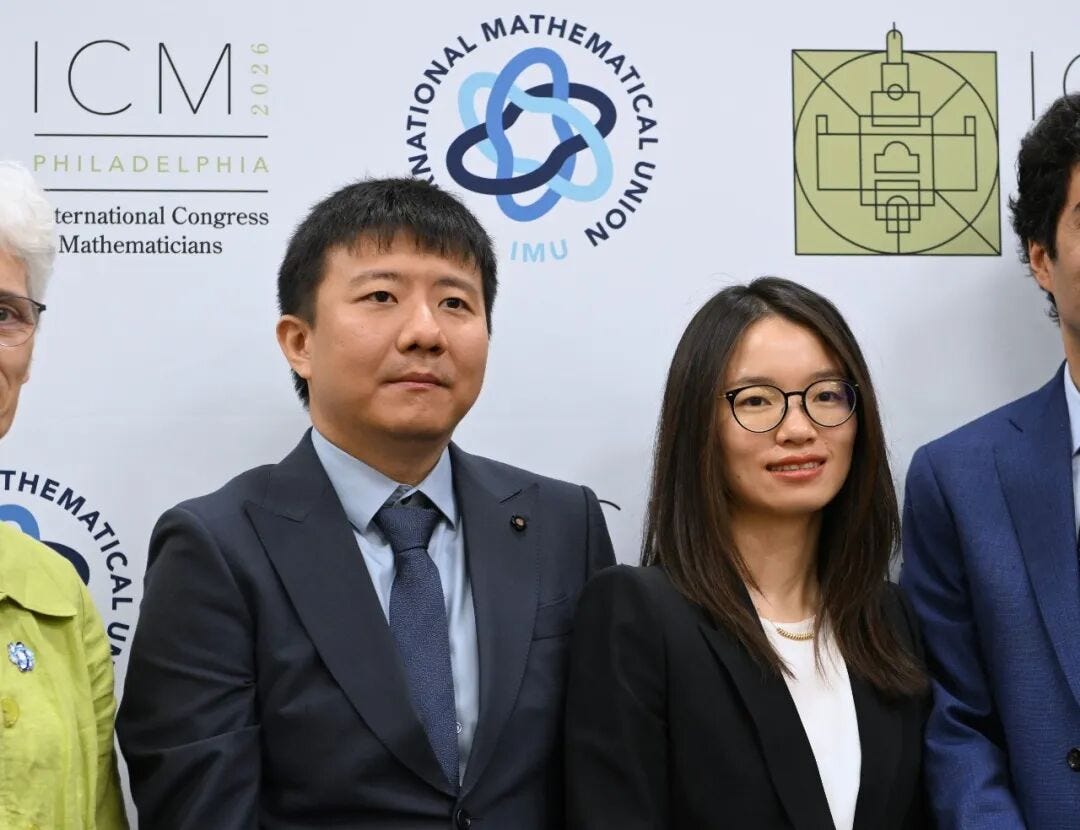
“Why are Chinese people so good at math?”
It’s a decades-old trope that refuses to die, endlessly bouncing around Western subreddits and Chinese social media alike.
Look, from a purely statistical standpoint, this idea doesn’t really hold up. When you consider a massive base of 1.4 billion people in mainland China—plus a huge global diaspora—the statistical magic largely collapses on its own. It barely warrants a serious debunking. But hey, I’m not here to completely shatter the myth today. After all, as far as ethnic stereotypes go, it’s mostly benign and harmless.
So, why does the story persist? Internet forums usually offer two painfully logical explanations. Let’s break them down—and then knock them over one by one.
Myth #1: The Linguistic Shortcut
The first argument points to language. Years ago, I caught a stand-up comedy bit roasting the sheer madness of counting in English. The comic pointed out how, the moment you pass ten, English arbitrarily throws out eleven and twelve before settling into a regular pattern. It’s an unnecessary cognitive roadblock for a toddler. By contrast, East Asian languages—especially Mandarin—are brutally linear, logical, and strictly base-10. The logic goes: Chinese kids get a head start simply because their language doesn’t sabotage them during step one of counting.
Sounds super convincing, right? If you’re nodding along, let me hand you an even crazier piece of “evidence.” If you think English is bad, wait until you hear French. You don’t need a PhD in linguistics or child psychology to see how wild this gets—nobody explains it better than comedians on TikTok or YouTube Shorts. Go search for it if you want a laugh.
The classic example? French doesn’t even have a single, dedicated word for the number “99.” To say 99 in French (quatre-vingt-dix-neuf), your brain literally has to perform multi-step arithmetic on the fly: “four times twenty plus ten plus nine.” It’s so much unnecessary information that you’d swear a French toddler’s brain gets fried just learning to count.
And right there, the “linguistic advantage” idea completely crumbles.
Why? Because France—the nation with the most absurdly complex counting logic on Earth—happens to be one of the most formidable mathematical powerhouses in human history. From Descartes, Laplace, and Fourier to the modern Bourbaki school, the French have practically owned half of modern mathematics. Even this year, when China’s home-grown genius Hong Wang won the 2026 Fields Medal, a pivotal station of her intellectual transformation was none other than Paris—the capital of counting-by-multiplication.
Myth #2: The Multiplication Table Trick
The second popular theory is the Nine-Nine Multiplication Table (九九乘法表). The idea is that Chinese kids memorize a catchy, highly rhythmic 10x10 multiplication grid by age seven. Once it’s hardwired into their heads, they get an early-stage confidence boost that keeps them ahead of the curve for years.
Here’s the easy counter-argument: China isn’t unique here. Kids in India, for instance, are often pushed to memorize a staggering 20x20 multiplication table. If early-childhood table-memorization was the secret sauce, Indians would hold an even stronger cultural monopoly on this stereotype.
More importantly, we rarely talk about the nasty side effects of mechanical look-up tables on raw mathematical intuition. Rote recall might help with early language learning, but relying on pure memorization in STEM—where curiosity and logic rule—is a terrible way to build long-term talent. It gets you down the road faster initially, but in completely the wrong direction.
Historical Kinetics: The “Principle of Least Action”
If it isn’t language and it isn’t multiplication tables, what’s the real engine behind this “Chinese Math Storm” sweeping through global Olympiads, Silicon Valley quants, and cutting-edge AI labs?
To see the truth, we have to look past internet lore and analyze history and complex systems. Frankly, the exact same dynamics explain why South Korea, Taiwan, Hong Kong, and Singapore built massive mathematical edges well before mainland China did. It’s only because China’s massive population and economic footprint are now hitting the global stage that this has been reframed as a “China issue.”
The first mechanism is the sociological equivalent of the Principle of Least Action.
In physics, the Principle of Least Action dictates that nature always moves along the path of least resistance, lowest energy loss, and steepest gradient. Light refracts; water flows to the sea.
This physical law maps onto modern Chinese history since 1840. Facing systemic crisis and industrial backwardness, an entire society was saddled with a desperate mandate to catch up. But in a high-friction geopolitical environment, intellectual breakthrough paths were severely restricted. Trying to adopt foreign political institutions brought immense domestic friction and upheaval. Pursuing cutting-edge physics, chemistry, or advanced engineering required heavy capital, expensive machinery, and modern labs—things a poor, resource-scarce society simply didn’t have.
Mathematics, however, was different. It’s the foundational busbar of all natural sciences, but more importantly: it is the poor man’s nuclear weapon.
Math requires zero capital, zero imported hardware, and zero fancy infrastructure. Armed with nothing but raw gray matter, a pen, and scratch paper, a kid sitting at a rickety wooden desk could engage in a sharp duel with a professor at Princeton. The nation’s intellectual capital, like groundwater seeking a slope, naturally flowed into this path of least resistance.
Scale Effects and Overshooting
Once that path proved viable, the system developed an intense path dependency, triggering a second dynamic: Scale Effects & Overshooting Feedback in complex systems.
In a massive societal matrix with low per-capita resources, the moment a specific pathway (like grinding STEM or acing the Gaokao) is proven to be the most reliable ladder for social mobility or national survival, the entire system kicks into a terrifying positive feedback loop.
Government policies, school KPIs, intense parental expectations, and individual grit all stack on top of each other. The whole society starts “involuting” (卷). This total-population involvement drives investment—time, energy, money—far past the normal balance point, creating a macro-phenomenon where an entire nation is obsessed with STEM.
When this overshooting engine roars, its K-12 byproduct is the hyper-brutal culture of test-oriented “grinding” (刷题 culture). Elite academics constantly criticize this rigid machine for crushing creativity. But objectively speaking, it acts as a massive industrial centrifuge, filtering out a staggering baseline of hard analytical skills. The sheer volume of raw processing power generated by this demographic scale is something a small, boutique Western elite education system simply cannot replicate.
Outbound Grinding: The Mastermind and the New Vanguard
When this hardened mathematical skeleton—forged by the overshooting energy of 1.4 billion people—spills over globally through immigration and talent circulation, a true tidal wave occurs.
In open Western academic environments featuring personal freedom and abundant resources, diaspora students carrying this Chinese math skeleton deploy their bulletproof baselines to run circles around their peers. In recent years, Team USA at the International Mathematical Olympiad (IMO) has repeatedly fielded what observers jokingly call an “Near-all-Chinese lineup.”
Behind this diaspora surge stands a crucial figure: Carnegie Mellon math professor Po-Shen Loh. As the former head coach of the US IMO team, Loh has spent a decade breaking a 20-year championship drought, regularly beating Team China since 2015. He achieved this by blending the rigorous discipline of Chinese foundational training with Western, interest-driven problem-solving.
If you’ve only read about America’s recent IMO streak in the news without knowing who engineered it, go watch Po-Shen Loh’s YouTube interviews—it’s well worth your time.
Since our recent math deep-dives were sparked by Hong Wang’s Fields Medal, let’s talk about the rising generation of female mathematicians. Look closely at the “Near-all-Chinese” US team photos in 2024 when the US beat China again and won the championship, and you’ll spot a breakout prodigy: Jessica Wan.
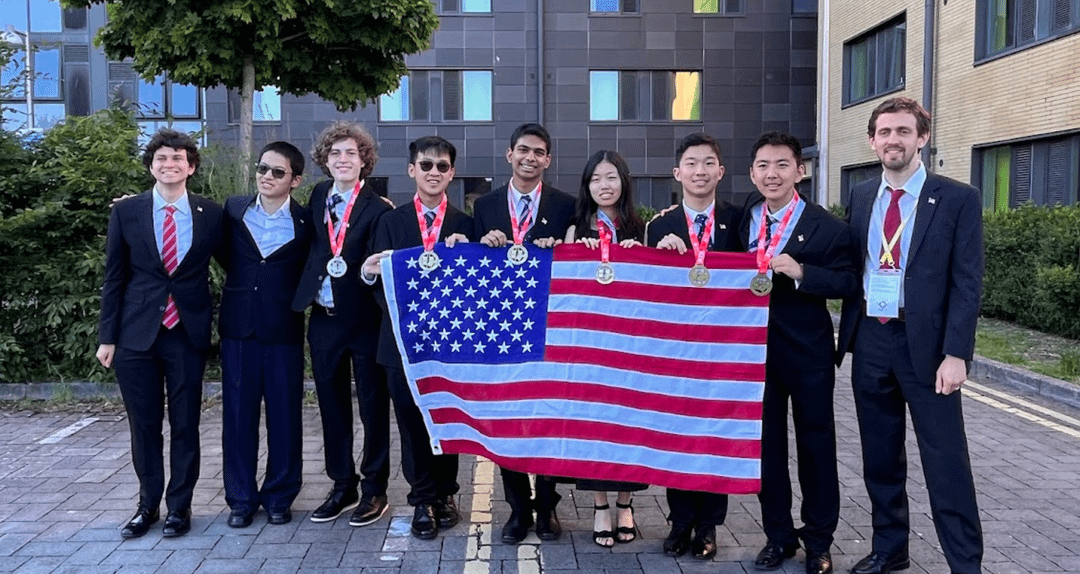
Jessica is the first female mathematician in history to make the US IMO team in consecutive years and win gold. In high school, she utterly dominated events like the European Girls’ Mathematical Olympiad (EGMO) with perfect scores. Now an undergraduate student at MIT, she’s a name every math enthusiast should keep an eye on. In my book, she has all the makings of the next Hong Wang.
Reshaping AI: Connecting Eastern Skeletons to Silicon Valley Compute
These mathematical elites aren’t just staying in ivory towers. If you look past the Fields Medal podium to today’s AI revolution driven by compute and algorithms, the real-world stakes become obvious.
Strip away the PR fluff and VC hype around modern AI. At its absolute core, the current AI boom is pure math—the engineering monetization of linear algebra, probability theory, topology, and differential geometry. Whoever possesses elite mathematical intuition and multi-dimensional tensor control holds the keys to AGI.
This explains why, in the eye of the global AGI storm—from OpenAI, Anthropic, and Google DeepMind to top quantitative hedge funds—Chinese and Chinese-diaspora mathematicians and AI researchers are present in overwhelming numbers. They dominate core architecture teams and author lists on foundational papers.
The Eastern mathematical skeleton has found its ultimate host in Silicon Valley. When a mind equipped with brutal foundational discipline gets plugged directly into world-class supercomputer clusters, massive capital, and a culture of disruptive innovation, you get a powerful technical engine. They are writing the literal equations bridging humanity to AGI.
Epilogue: Soil, Serendipity, and Geniuses on the Horizon
There’s a popular book lately titled Why Greatness Cannot Be Planned. That premise holds immense weight in the history of science. No bureaucrat can draft a blueprint to “manufacture” an Albert Einstein. The same goes for Hong Wang. She is an absolute, generational genius—an accidental mutation in complex system evolution, not the deterministic output of a state machine. Attributing her success entirely to a grand national plan erases her personal resilience and misunderstands scientific discovery.
That said, while the spark of genius is accidental, its growth requires soil.
During the era of tragic number theorist Chen Jingrun, closed domestic systems and extreme material scarcity meant a brilliant mind burned out early in a tiny, unheated room. That was terrible soil. By contrast, in Hong Wang’s era, China’s domestic baseline combined with global mobility provided a way better growth environment.
Meanwhile, overseas Chinese communities offer an even more fascinating hybrid petri dish. They retain the operational discipline, drive, and parental investment of Eastern training, while breathing the open, forgiving, and boundary-pushing air of Western academic freedom.
In this blended soil, Po-Shen Loh represents the bridge-builder, Jessica Wan represents the breathtaking new vanguard, and Hong Wang—who forged her baseline in China before expanding her theories across Paris and Boston—represents the ultimate zenith of what global talent circulation can achieve.
Greatness cannot be planned. But as long as fertile soil remains fluid and interconnected, a massive wave of geniuses is already on the way.
【End of Series】
Hit the Subscribe button below to lock in your access. As the technological tides roll forward, we will continue to bring you the sharpest, most analytical breakdowns on global tech, AI, and geopolitics. See you next time.