

On July 22, 2026, John J. Mearsheimer published an article in his Substack column. In the piece, he mentioned participating in an online interview a couple of days earlier where the topic was: Why can’t Donald Trump achieve victory in the Iran war he launched on February 28 of this year?

Mearsheimer’s view was explicit. In his assessment, the U.S. military’s current “tit-for-tat” tactical escalation not only fails to resolve the underlying problem, but actually worsens the situation step by step. Worse still, Washington currently holds zero escalation options that could break the stalemate without triggering an even greater disaster. To define this predicament, he compared the current Trump administration to the Johnson (LBJ) administration bogged down in the Vietnam War, predicting that the U.S. would ultimately be forced to bow its head, return to the negotiating table, and accept conditions far harsher than previous agreements.
Seeing an old-school realist master whom I have long respected make such an analogy, my knee-jerk reaction was: Is this rhetoric, which directly equates the current reality to the Vietnam War, taking things a bit too far?
If you carefully check the underlying military facts, you’ll find that the two are completely different beasts. In Vietnam, at its peak, the U.S. military mobilized over 500,000 ground troops, instituted a nationwide draft, and fought an all-out war of attrition deep in the jungle that consumed the lives of an entire generation of young Americans and drained the country’s financial lifeblood.
And today in Iran? The U.S. military hasn’t even broken a sweat so far—there are no large-scale ground forces moving in, no domestic draft, and zero total societal mobilization. A crucial and unique strategic fact is that from the initial campaign plans of the Trump administration and the War Department right up to the present, the U.S. military has never had any intention of deploying ground troops to mainland Iran.
Although the U.S. military initially made verbal threats about landing on strategic strongholds like Kharg Island to completely sever Iranian oil exports, as the air and sea blockade became a reality, the necessity for such landings—already minimal—vanished entirely. Aside from anxious critics warning “not to repeat past mistakes,” there is zero factual evidence indicating that the U.S. military would execute physical occupations and regime takeovers as it once did in Afghanistan or Iraq. The option of “refusing ground intervention and discarding long-term occupation” was completely ruled out by the White House from day one. This highly constrained mode of intervention is precisely the most unique characteristic of this round of conflict.
Forcing together two conflicts that are worlds apart in terms of mobilization scale, form of intervention, and cost of sacrifice inevitably lacks precision. In fact, if you really want to make a comparison with past U.S. military actions in the Middle East, never mind Vietnam decades ago, defining this as a carbon copy of the “2003 Iraq War” would likely be far too premature.
However, why do we still need to take Mearsheimer’s anxiety seriously?
Because if we peel away the slightly exaggerated rhetoric meant for public dissemination, the underlying concerns expressed by figures like Mearsheimer and Niall Ferguson are entirely valid: From the very beginning, the strategic motivations and calculations of this war were utterly terrible. The U.S. casus belli was extremely flimsy, preliminary political preparation was severely lacking, and the economic and precision-munition costs consumed behind tactical execution are terrifyingly expensive.
Observing today’s public discourse, you’ll notice a very peculiar phenomenon: at this current moment, across the global think tank community and strategic circles, you can hardly find a single clear-headed individual brave enough to publicly assert that the U.S. can “easily win this war.”
So, this poses a strange question: Why is a military as powerful as the U.S. struggling and looking so awkward when facing an opponent like Iran?
Frankly, John J. Mearsheimer’s intuition in comparing Trump to LBJ and the Iran war to Vietnam is very intriguing. He inadvertently prompted me to dig back into history.
Aha, confirmed.
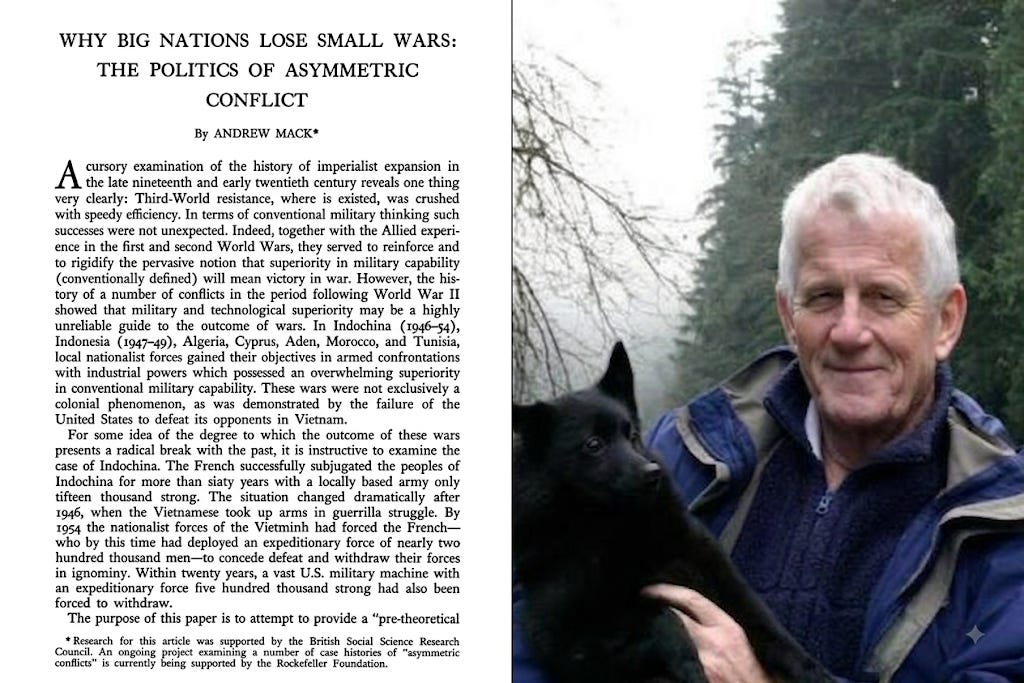
Andrew Mack, a famous scholar in Cold War strategic studies, published his landmark, frequently cited paper in World Politics in 1975, right as the Vietnam War ended in ignominious retreat: “Why Big Nations Lose Small Wars.”
So, to understand the current box the U.S. military faces, we might as well review Mack’s theory together to see his two underlying logics explaining the Vietnam failure, and how those logics magically apply to today’s Iranian battlefield.
1. The Vietnam Legacy and Mack’s Analysis
When the U.S. military evacuated Saigon in 1975, the Western strategic community was actually filled with confusion: the U.S. possessed a powerful defense industry and high-intensity bombing capabilities, so why did it ultimately fail to defeat North Vietnam? At the time, the Pentagon habitually blamed political interference or media coverage, whereas Mack attempted to propose two observations from a structural perspective:
A. Asymmetry of Conflict Goals
Mack argued that the goals pursued by big powers and small nations in these types of wars exist in completely different dimensions.
Big powers fight a “War of Choice”: The outcome of the war concerns prestige or localized interests, but does not involve the big power’s own survival. Therefore, a big power naturally has an upper threshold for its tolerance of financial, ammunition, and personnel losses.
Small nations fight a “War of Survival”: Facing an existential crisis, a small nation or resisting regime typically defines “victory” very modestly—as long as the regime structure hasn’t completely collapsed, and as long as it can still make its voice heard from the rubble, it hasn’t lost tactically.
You see, applying this logic to today’s Iranian battlefield fits like a glove. For the White House, this airstrike campaign against Iran is entirely a “War of Choice.” If Trump suddenly feels the cost is too high one day, announces some verbal agreement, and unilaterally pulls back, the U.S. mainland faces no substantive threat, and he won’t necessarily lose politically. But for Iran’s Islamic regime and the Islamic Revolutionary Guard Corps (IRGC), the situation is the exact opposite—this is a thorough, out-and-out crisis of survival. Once the regime completely loses control or is defeated, it means the end of ruling legitimacy and personal doom for them. Therefore, they will use every possible means to fight to the end; as long as the regime structure doesn’t collapse, they have survived strategically.
B. Political Attrition within Democratic Systems
Mack also observed the phenomenon of diminishing political will within democratic nations:
Misalignment between Participation and Benefit: In this type of asymmetric conflict, ordinary voters often feel no direct benefit from the war, but instead must bear costs like inflation or higher taxes. When people feel this has nothing to do with them, using their votes to oppose the war becomes a natural default.
The Impact of Information Dissemination: Mack’s theory was born in the era of the “television war.” Evening news broadcasts displaying images of bombings and civilian casualties could easily cause psychological shock to the public at home, which in turn prompted voters and Congress to pressure decision-makers.
Mapping this against today’s Iran conflict, information dissemination has long evolved from the evening TV news of Mack’s era into millisecond, real-time streaming on TikTok and X. The U.S. military’s firm determination not to send ground forces this time—aside from avoiding a long-term quagmire—also stems from a very realistic reason: avoiding the kind of scenes the Israeli Defense Forces (IDF) faced in Gaza. Once ground troops enter, high-definition war devastation and security conflicts are broadcast live in milliseconds via smartphones across the globe, instantly thrusting the U.S. military into the crosshairs of political and public backlash. The unfortunate bombing of the Minab school on the very first day of the war in February sparked an immediate firestorm. To this day, we have yet to see an official U.S. admission or denial, but it was undeniably passive and deeply disappointing.
2. Technology’s Entry and the Confidence Brought by the “Chip War”
Of course, looking back, when Mack wrote these words in 1975, he also had the limitations of his era. For instance, he might not have foreseen how dramatically the subsequent “Revolution in Military Affairs” would alter the nature of warfare.
In the era Mack was writing, American bombing methods largely continued the practices of World War II and the Korean War. A major reason the Vietnam War ended so awkwardly was that the technological gap between U.S. and Soviet weaponry had not widened. During the Korean War, the U.S. continuously bombed the Yalu River banks and rear supply lines, but failed to completely sever the Chinese People’s Volunteers’ material supply. The same was true for most of the Vietnam War. On the “Ho Chi Minh Trail,” used by North Vietnam to transport supplies, sat a key transportation hub: the Thanh Hóa Bridge. Between 1965 and 1972, the U.S. military dispatched a massive number of aircraft, dropped thousands of tons of conventional bombs, and paid the price of dozens of downed jets, all without managing to destroy the bridge.
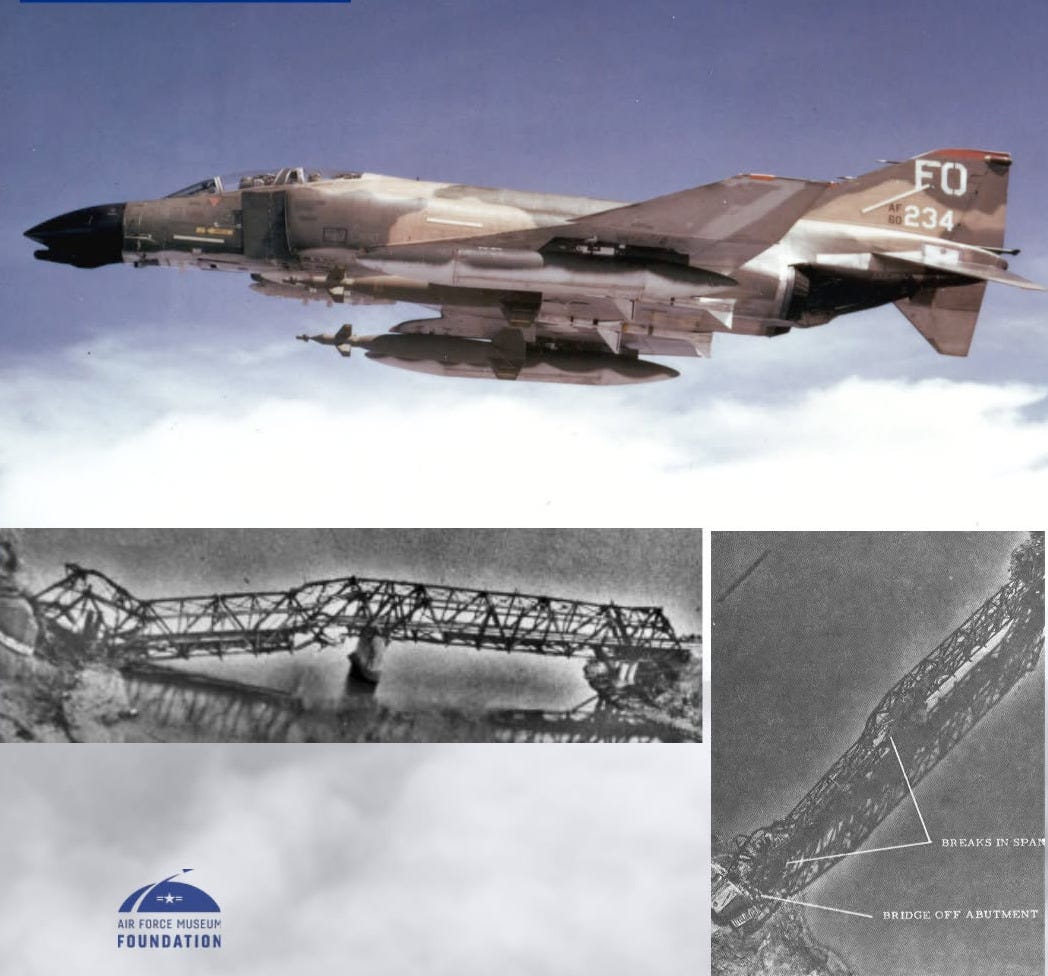
It wasn’t until May 1972 that the U.S. military began deploying first-generation “Paveway” laser-guided bombs in actual combat. Flying a small flight formation, the U.S. dropped guided bombs that precisely struck critical structural points, finally dropping the bridge.
This detail is fascinating because, to some extent, it inaugurated what people later referred to as the “precision-guided era.”
Over the dozen-plus years between the end of the Vietnam War and the outbreak of the 1991 Gulf War, the U.S. military solved the problem of technological lag exposed in Vietnam. As Chris Miller details at the beginning of his book Chip War: it was advanced semiconductors, microprocessors, and optical sensors developed in Silicon Valley that re-equipped the U.S. military, executing a transformative overhaul that completely opened up a generational technology gap against Soviet-legacy weaponry.
Backed by Silicon Valley tech, from the 1991 Gulf War to the 1999 Kosovo War, and on to the early stages of Afghanistan in 2001 and Iraq in 2003, the U.S. military relied on stealth aircraft and precision-guided weapons to showcase a highly efficient template for high-tech, rapid victory. During that stretch, many began to doubt Mack’s original inference that “big powers will inevitably fall into internal attrition”—people felt that by relying on the absolute technological gap provided by Silicon Valley to destroy the opponent’s command hubs from 30,000 feet with low casualties, one could seemingly bypass the domestic political war-weariness Mack spoke of.
If the U.S. military had called it quits immediately after crushing Saddam’s main forces in 2003 instead of staying behind to conduct twenty years of “nation-building,” Mack’s theory might indeed have been shelved by technocrats for good.
3. New Changes in 2026: Why Is Mack’s Logic Being Raised Again?
If the U.S. military once built such strong confidence on the tech granted by Silicon Valley, why are figures like Mearsheimer getting anxious again on the 2026 Iranian battlefield? What physical conditions have actually shifted over these past few years?
Personally, I think a few real-world details are well worth breaking down:
1. Technology Proliferation and “Democratization”
In 1991, the opponent faced by the U.S. suffered from an obvious technological gap. But today in 2026, technology spreads extremely fast. Iran and its proxies possess a substantial number of suicide drones and ballistic missiles. When these relatively low-cost weapons begin executing saturation attacks, the U.S. military’s high-altitude technical barrier is no longer as absolute as it was thirty years ago.
2. Precision Munition Costs and Mass Production Bottlenecks
Undeniably, U.S. precision-guided weapons remain very effective in 2026. The heavy bunker-busters Trump ordered early in the war did indeed demonstrate the capability to strike high-value, deep-seated targets.
The problem, however, is that these weapons are not only expensive, but their mass production speed cannot keep up.
In industrial production, there is a piece of common sense: if an item lacks sufficient mass production scale and its supply chain is too long, it is bound to be expensive and extremely difficult to replenish once exhausted. The U.S. military now faces a rather awkward math problem—frequently using single Patriot or SM-3 interceptors costing millions of dollars each to offset the opponent’s drones or basic missiles costing tens of thousands of dollars a piece.
This mode of consumption—“hurling the price of a luxury school-district condo to knock out the opponent’s electric bike”—is something no major power’s treasury or defense inventory can sustain over time.
3. Rare Earth Supply Chains and Geopolitical Constraints
Here are two constraint factors that people discuss often in peacetime, but become brutally real during war:
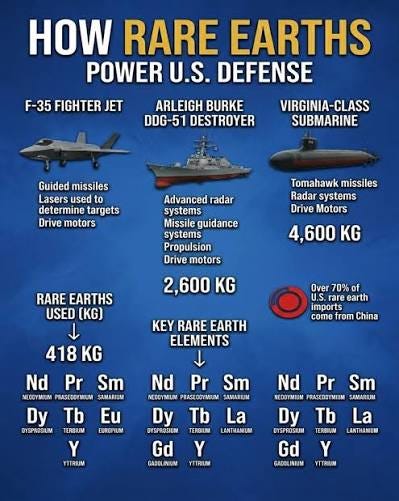
Rare Earth Supply Chains: Advanced U.S. weaponry (including radar coatings for stealth jets and guidance components for missiles) relies heavily on rare earth supply chains. This widely known vulnerability attracted widespread attention during recent trade frictions. When precision munitions are consumed in vast quantities, attempting to rapidly expand production capacity at the rear hits a bottleneck at the raw material level.
The Strait of Hormuz: Just like the Strait of Hormuz acting as a sensitive geopolitical pressure point, the U.S. and Israel have to tread carefully when making decisions. Iran controls the edge of the Strait, making it difficult for the West to escalate the war into an all-out invasion without hesitation; if something goes wrong in the Strait, global oil prices and inflation are costs no one can afford.
4. Ordinary People’s Economic Experience and War-Weariness
Today’s American middle class and voters are not having an easy time under inflationary and economic pressures. Most of the profits generated by war flow into defense contractors, while what ordinary people perceive are mainly high gas prices and deficits. Coupled with current social media transmitting war footage to everyone’s phone screens in real-time, whether it is the Left’s humanitarian concerns or the Right’s MAGA camp demanding “America First” and reduced overseas involvement, a widespread sentiment of war-weariness has objectively taken shape.
5. The Anti-War Impact of Real-Time Information Dissemination
After the U.S. and Israeli militaries issued severe strike warnings against Iranian strategic targets early in the war, Iranian authorities rapidly adopted extremely systematic countermeasures.
First, organizing “human chains” and protests: The Iranian government indeed organized tens of thousands of ordinary citizens, students, and Basij militia members to gather around critical infrastructure like the Bushehr Nuclear Power Plant, Ahvaz power plant, key bridges, and desalination plants.
Second, highly targeted media dissemination: Live footage was broadcast at high frequency by Al Jazeera and Iranian State TV (IRIB), showing citizens raising national flags and forming “human defense lines” in front of critical infrastructure, speaking directly to the world through the camera lens.
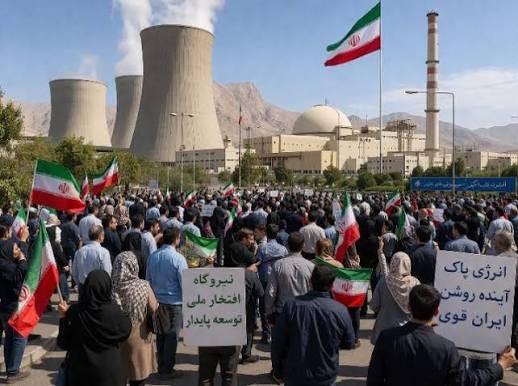
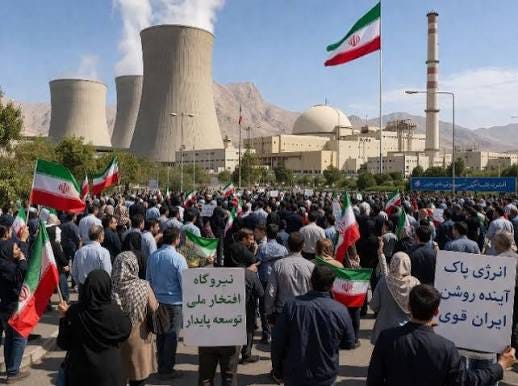
In terms of communications theory, this constructed immense public opinion pressure—any strike against these facilities would immediately be re-broadcast in real-time as evidence of “U.S. forces massacring innocent civilians.” The “Minab school tragedy” on day one of the conflict already forced the U.S. military to pay a heavy political price diplomatically and in international public opinion; the Pentagon has become extremely sensitive and restrained when selecting targets that risk expanding civilian casualties.
All of the above are real physical, economic, and tactical issues affecting military capabilities. Notice what we haven’t brought up? We haven’t mentioned the contributions of passionate pacifists and anti-war groups of various motivations making clamor on TikTok and X across the Western internet. Why? Because frankly, across every U.S. war since World War II—with the exception of 1991, which was fought under a UN mandate with numerous allies, backed by cross-generational weapons, and most importantly, won easily and swiftly—every other war faced opposition, with the opposition ratio usually hovering around 50%. In other words, almost every post-WWII war fought by the U.S. military was conducted with only half the population supporting it, win or lose.
So, my apologies to the pacifists—I am not saying that calling for peace, justice, and the reduction of slaughter is unimportant. It is actually very important. But war operates on its own cold logic. You can still love peace while flipping through Sun Tzu and Clausewitz, or, as we are doing right now, reading Andrew Mack’s paper to analyze a war’s starting point, evolutionary trajectory, and endgame.
4. Some Reflection: Is U.S. Military Confidence Undergoing a Shift?
Early in the war, the Trump administration ordered heavy bunker-busters to successfully decapitate Iran’s senior leadership. To me, this looked very much like the U.S. military attempting to prove to the outside world: Look, we still possess that 1991 capability to resolve issues through absolute technological superiority.
Yet this leaves behind the single biggest question mark on the 2026 Iranian battlefield: Is this high-altitude bombing and decapitation tactic a continuation of U.S. dominance, or a forced, bare-minimum effort under realistic constraints?
From Mack’s theory in 1975, to the technical confidence ushered in by Silicon Valley chips and precision-guided weapons after the Thanh Hóa Bridge in 1991, and down to 2026 where production limits, rare earth dependencies, and exorbitant costs cause hesitancy—has the U.S. military’s past ability to effortlessly handle asymmetric conflicts through technical dominance hit a new ceiling, or worse, is it undergoing an irreversible change?
When expensive ammunition depots face replenishment hurdles, voters at home express war-weariness, and the opponent can still make its voice heard from the rubble, it is no wonder everyone is recalling the words written by Andrew Mack fifty years ago.
5. The Probable Endgame: “Strike Hard, Sign Fast”
No matter how fragile or intermittent the ultimate agreement turns out to be, a ceasefire is the common hope of almost every player involved (including the Gulf states, American voters, Tehran, and even distant Moscow and Beijing), with the sole exception of Netanyahu’s far-right wing in Israel.
Tehran’s primary demand is forever the survival of the theocratic regime—a tacit understanding that has already succeeded.
However, a troublesome aspect of this round of war is that it explicitly ignited the issue of Strait management rights. Previously, the idea that Iran might block the Strait of Hormuz to force the world to its knees existed purely in theory, but this conflict brought that contradiction out into the open.
Iran now insists on holding approval rights over oil tanker transits, which serves as a red-line issue causing stalemate in negotiations.
All constraints on the U.S. side are public knowledge. The approaching midterms, persistently high oil prices, re-emerging U.S. CPI inflation, sharp stock market volatility, and particularly the public revelation of U.S. ammunition shortages—Tehran won’t miss a single one of these negative signals. On the other hand, the Iranian theocratic regime, having recovered from the initial passive beatings, finds itself isolated and surrounded, yet it has tightened internal blockades with brutal suppression, making it impossible for the outside world to deduce its actual decision-making path.
Regardless, if Tehran believes it can leverage this position to dictate terms to the international community, further military exchanges and continued strikes may prove difficult to avoid. Taking into account both battlefield dynamics and diplomatic trajectories, the most probable endgame format remains a calculated sequence: the U.S. and Israel deploy a final round of high-intensity strikes to maximize their leverage, followed immediately by a swift move to secure a ceasefire or nuclear agreement—allowing all primary parties to exit the confrontation before costs escalate further.