

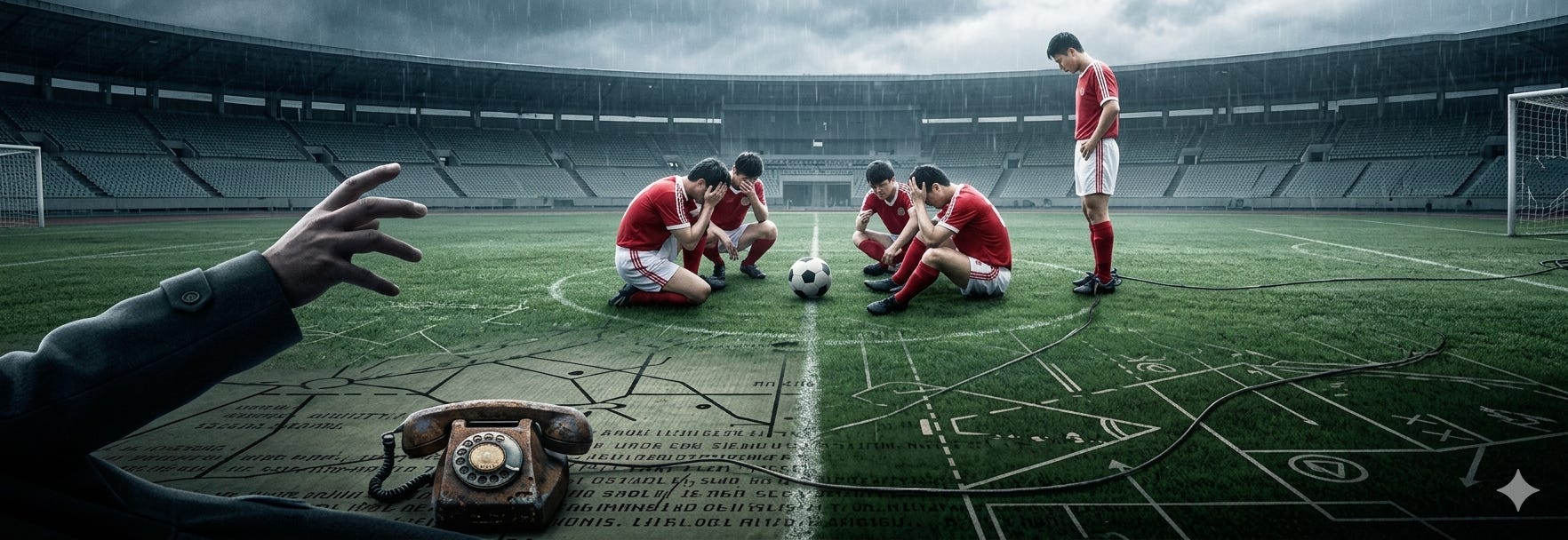
Who is the single most influential figure in the history of Chinese football—the one who left the deepest, most indelible imprint on its fate?
Gosh, I truly wish I could give you the name of a transcendent megastar here, someone akin to what Yao Ming was to basketball.
Or, at the very least, the name of a truly great manager who once successfully guided the squad onto the grandest global stage.
But I am sorry; Chinese football possesses none of these. You don’t even need to waste your time on Google searching for any Chinese player. Throughout the half-century of this sport’s turbulent rise and fall, not a single name on the pitch has ever been worth remembering.
Because the individual who truly reshaped the destiny of Chinese football, thrusting it into its inescapable tragic orbit, was a fan.
A genuine football fan.
It just so happened that he also possessed another identity far better known to the rest of the world—Deng Xiaoping.
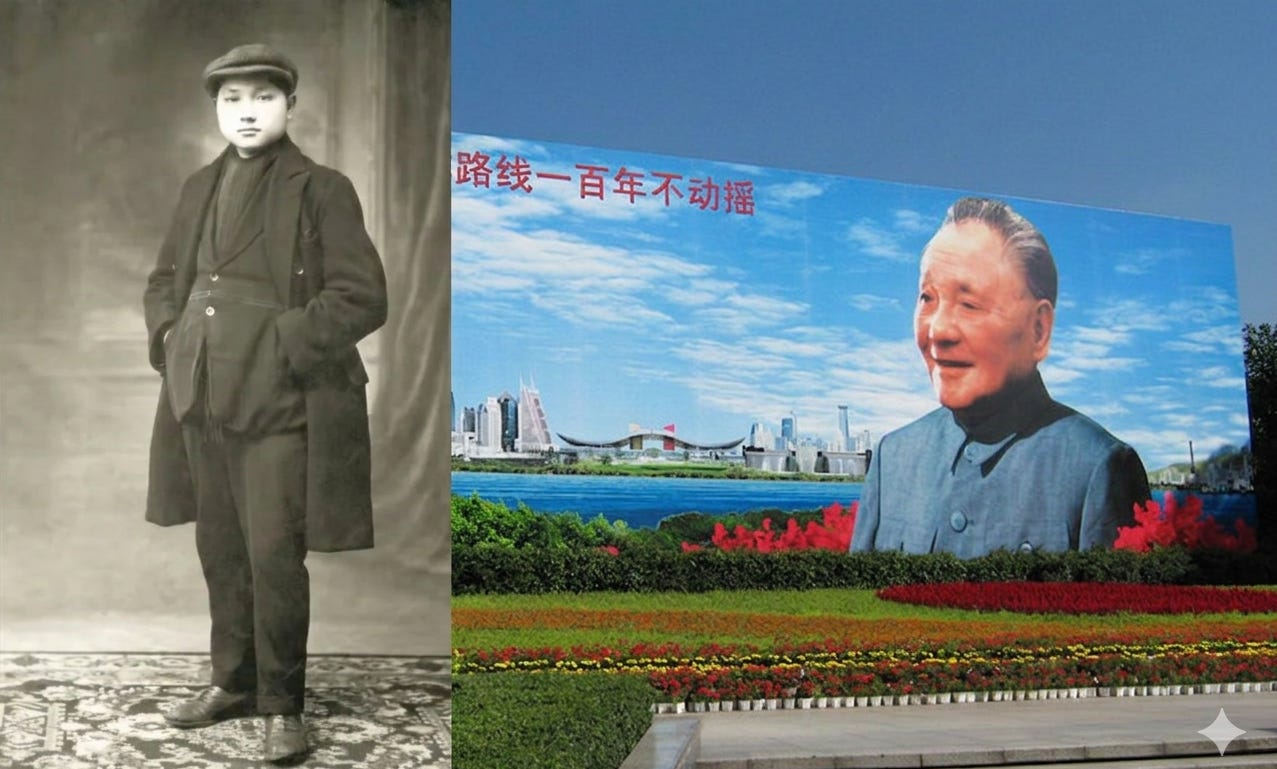
Act I: The Overcoat in Paris and the Stands of Workers’ Stadium
In the summer of 1924, Paris, France. A twenty-year-old Deng Xiaoping was participating in a work-study program, living in extreme, grueling poverty. That year coincided with the 8th Summer Olympic Games. Desperate to catch a glimpse of the legendary Uruguayan national team, who were taking the world by storm with their brilliant short-passing game, Deng pawned the most valuable possession he owned—his woolen overcoat.
With the meager few francs he received in exchange, he bought the cheapest football ticket available to get into the stadium.
More than fifty years later, in his twilight years at Zhongnanhai, while watching football matches with his family and aides, Deng could still flawlessly recite the teams and the exact scoreline of that match from memory:
“It was Uruguay against France. Uruguay crushed France 5 to 1. It was an absolutely spectacular match!”
This profound obsession with the sport eventually transformed into a highly unique symbol within his political career.
In July 1977, having survived the catastrophic upheavals of the Cultural Revolution, Deng Xiaoping ushered in the third political resurrection of his life. All of China, and indeed the entire international community, held its collective breath, watching intently to see which political venue the future Grand Architect of China would choose to stage his first formal public appearance.
To everyone’s utter astonishment, on the evening of July 30, Deng appeared in the VIP stands of the Beijing Workers’ Stadium. The moment the stadium loudspeakers suddenly boomed with the announcement of his name, the crowd of eighty thousand spectators rose to their feet in a thunderous, roaring ovation. This was far more than a mere political debut; it was a massive, high-level release of public sentiment, beautifully brokered through the medium of football.
As the helmsman steering the course of a massive nation, he truly understood the game, and he genuinely wished for Chinese football to prosper. In the years that followed, he repeatedly articulated a grand vision that still echoes across the country today: “Football must be grasped from the cradle.”
Yet, within this massive and hyper-sensitive apparatus of absolute authority, a leader’s pure, unbridled passion almost always evolves into a suffocating net of administrative pressure.
Act II: The Mysterious Phone Call and Chinese Football’s Waterloo
May 19, 1985. Once again, the Beijing Workers’ Stadium.
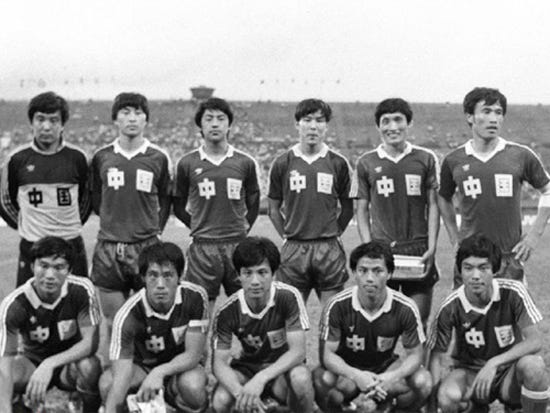
This was a critical, high-stakes qualifier for the 1986 FIFA World Cup in Mexico: China vs. Hong Kong.
The Chinese national team at the time was widely considered its “Golden Generation,” vastly superior in raw talent to Hong Kong and holding a decisive goal-differential advantage in the group standings.
In other words, China merely needed a draw on home soil to historically advance to the next round.
The head coach, Zeng Xuelin, had formulated a highly rational, safety-first strategy: a disciplined, conservative defensive posture aimed strictly at securing a stable draw.
By halftime, the score was locked at 1–1. China was securely in control of its qualification destiny.
Inside the locker room during the interval, the manager reaffirmed the squad’s agreed-upon tactical plan. The players’ morale was soaring.
Suddenly, a landline telephone in the corner of the room—a phone that had sat covered in dust and untouched for years—rang out with a piercing, violent screech.
Ring-ring... Ring-ring...
The team director nervously picked up the receiver.
An incredibly stern, authoritative voice boomed from the other end: “Supreme directive! Put the head coach on the line immediately!”
The locker room instantly fell into a deathly, paralyzed silence.
The voice on the other end handed down a chilling command in an absolute, non-negotiable tone:
“Listen carefully! Here is your order: A draw is disgraceful. This is your home turf—you must attack! You must win! Do not just qualify; you must pile on the goals, unleash a dominant offensive fury, and justify yourselves to the entire nation!”
Click. Click. The line went dead.
Under the harsh glare of the locker room’s fluorescent lights, the faces of every man present turned a ghostly, bloodless white.
In that single fraction of a second, sound tactical reasoning was brutally overwritten by raw political authority.
When the whistle blew for the second half, a completely unhinged Chinese team abandoned all discipline and blindly poured forward in a desperate, frantic attack.
The pragmatic Hong Kong squad capitalized perfectly on a textbook counter-attack, clinical hitting the back of the net.
1–2. China collapsed.
Outside the pitch, an audience of eighty thousand, utterly unable to process this absurd disaster, erupted into the first massive, violent sports riot in the history of the People’s Republic—flipping luxury cars and tearing down stadium stands. The manager resigned in disgrace, and an entire generation of golden talent was thoroughly ruined.
While younger Chinese sports fans today might be entirely oblivious to these events, any fan with a bit of age remembers this date with perfect clarity: May 19, 1985—the absolute Waterloo of Chinese football history.
Act III: The Mayor’s Business Card and the Future Tycoon
As China transitioned heavily into a market economy, the top-down will of executive authority trickled down into the arenas of regional politics.
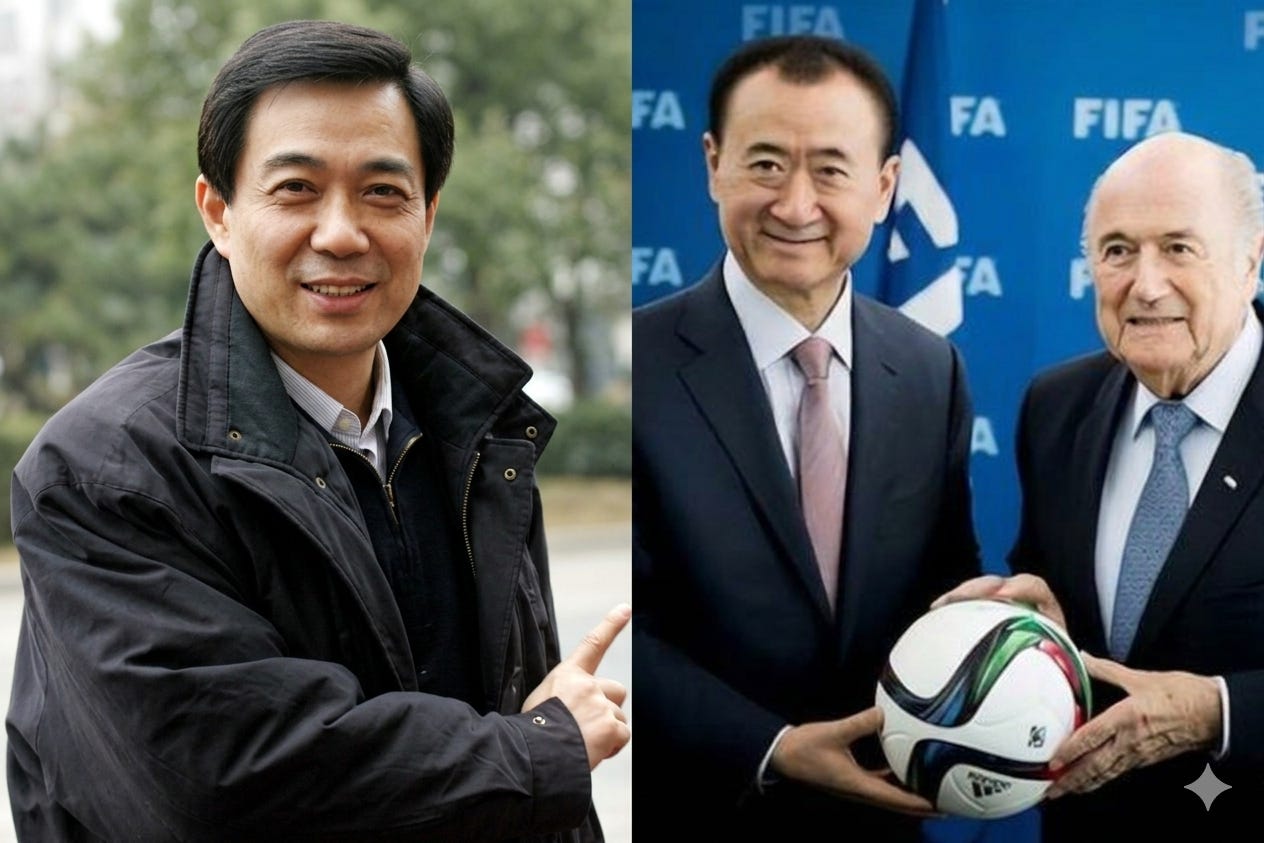
In the 1990s, the city of Dalian forged an incredible, legendary 55-match unbeaten streak, establishing the first true dynasty of Chinese professional football. Yet, the real puppet master pulling the strings behind this dynasty was the city’s ambitious young mayor, Bo Xilai.
In Bo’s grand political narrative, football was rebranded as Dalian’s most lucrative “city business card.” During every home match of Dalian Wanda FC, the mayor was invariably seated in the VIP pavilion. If the team won, he would march directly down into the locker room and personally authorize massive government financial bonuses on the spot.
Desperate to cater to the mayor’s signature brand of “football diplomacy” and high-profile political expectations, a local real estate tycoon named Wang Jianlin began pouring astronomical, reckless amounts of capital into the club.
(As a brief aside: this very real estate developer, Wang Jianlin, would go on to become the wealthiest man in China years later. We will dissect his story in great detail in a future installment.)
In Dalian, winning was never just about sport; it was about saving the mayor’s political face. From the very inception of Chinese professional football, its core DNA was indelibly warped into a mere appendage of regional political power.
Act IV: Erasing the Mechanism of Survival
By the year 2001, in an obsessive bid to secure a single, overriding bureaucratic metric—ensuring qualification for the 2002 FIFA World Cup in South Korea and Japan—the chief of the Chinese Football Association deployed absolute administrative power to issue a shocking decree that sent shockwaves through the sporting world: the indefinite suspension of the promotion-and-relegation system across all professional leagues.
The bureaucratic logic driving this move was incredibly blunt: to remain “laser-focused, pooling all national energy as a single chessboard” to guarantee the national team’s qualification, the commercial domestic leagues were viewed as a wasteful distraction that drained precious state resources. They had to be frozen.
In the mature context of Western professional sports, the promotion-and-relegation system serves as a crucial sword of Damocles that maintains competitive integrity. “Demotion” spells economic ruin—the catastrophic withdrawal of corporate sponsorships and total financial insolvency. This brutal punishment forces every single club to fight with genuine, ferocious intensity until the final whistle.
Yet, with a casual stroke of a bureaucratic pen, the Chinese Football Association completely wiped this existential mechanism of survival out of existence.
The result was a textbook institutional catastrophe. Once the threat of demotion vanished, a dozen clubs sitting in the mid-to-lower tiers of the table were instantly stripped of all competitive pressure and survival incentives.
Sporting integrity was utterly abandoned. Match outcomes degenerated into mere commodities that could be arbitrarily priced, bought, and sold under the table. Wealthy clubs desperate for promotion began aggressively buying off unconstrained opponents and systematically bribing match officials.
By the autumn of 2001, almost every team had plunged headfirst into brazen match-fixing. Matches transformed into meticulously choreographed theater, routinely producing farcical scorelines like 11–2 and 6–0 that insulted the intelligence of any viewer. In a matter of months, the entire domestic commercial football apparatus collapsed into total institutional decay.
Act V: The Dream of Revival and the Lightning of Wrath
The gears of history have turned to the present day.
When the current supreme leader, Xi Jinping, explicitly outlined his “Three World Cup Wishes” to foreign dignitaries—to host a World Cup, to qualify for a World Cup, and to win a World Cup—football was formally elevated into a core piece of the “Chinese Dream” of national rejuvenation.
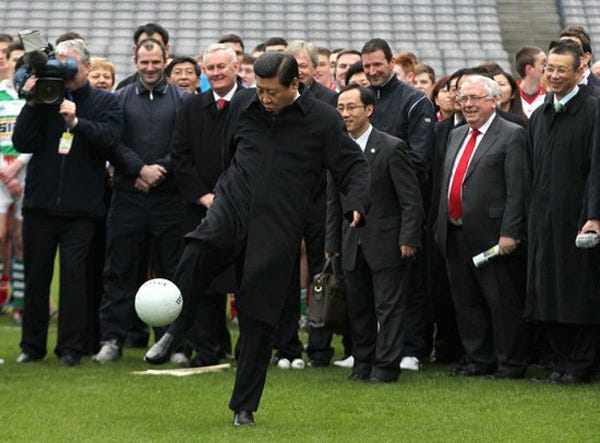
The massive bureaucratic apparatus and highly sensitive corporate capital immediately mobilized in an aggressive over-correction. Real estate titans poured trillions of yuan into the sport, municipal governments built sprawling “football towns” from the top down, and massive state resources were deployed to orchestrate the wholesale naturalization of foreign players.
Yet, this artificial facade of prosperity, engineered solely to appease policy directives, ultimately shattered against the icy reality of the national team’s dismal performances on the pitch.
What followed was a ruthless, military-style anti-corruption purge that swept through the entire industry, landing dozens of high-ranking football officials and national players behind bars. Absolute disciplinary rectification and high-pressure purges engulfed the sport.
But on a fast-moving, unpredictable football pitch, Chinese players—now playing while sitting on the edge of a volatile volcano—no longer think about creativity or creative flare when a pass comes their way. Instead, their minds are paralyzed by a single, terrifying thought: “Do not make a mistake. If I mess this up, will I be audited? Will I be investigated?”
Under the weight of absolute pressure, the system’s organic spontaneity has once again lapsed into dead silence.
Epilogue: The Strategic Blind Spot of a Grand Commander
The administrative command over Chinese football began with a young student in Paris pawning his overcoat; it journeyed through a century of pure passion mixed with clumsy intervention, manic investment, and iron-fisted crackdowns, only to arrive today at the prison bars of an anti-corruption purge. It is a flawless, tragic loop of logic. The more absolute administrative power demands total, flawless control over this decentralized art form, the faster it kills it.
To decipher the deeper historical code hidden beneath this crisis, we must train our eyes squarely back onto the primary protagonist of our story—Deng Xiaoping.
Without a shadow of a doubt, Deng Xiaoping was a brilliant and wise man. His perspectives on politics, economics, and international affairs were incomparably more open, pragmatic, and grounded in reality than those of his predecessor, Mao Zedong. Yet, at the exact same time, the imprint left upon his psyche by his years as a grand strategic commander during a brutal, unforgiving revolutionary war was simply too profound to erase.
Throughout his entire life, the achievement he spoke of with the greatest pride and relish was not the economic miracle of “Reform and Opening Up.” It was his military masterpiece during the Chinese Civil War: the Huaihai Campaign. In that rare, colossal steel storm of human history, Deng served as the Secretary of the General Front Committee, commanding an army of a million men and orchestrating a strategic miracle famously lauded by Joseph Stalin as “a tactical marvel of 600,000 defeating and annihilating 800,000.”
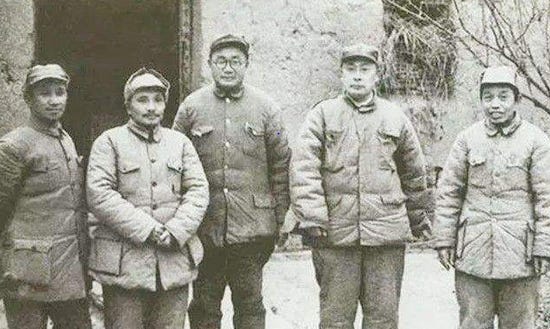
This spectacular military success solidified into an unyielding mental model that governed his governance style. When he ascended as the paramount leader of the Chinese Communist Party’s second generation in the 1980s, whenever he confronted complex social or systemic crises, his immediate, subconscious reflex was to deploy the military playbook of “grand campaigns” and “battles of total annihilation.”
Thus came the sweeping “Strike Hard” anti-crime campaigns that bypassed standard judicial due process to swiftly purge social elements; thus came the shocking, thunderous use of military force to crush the 1989 crisis.
His love for football was undoubtedly genuine. Yet, when that love reached its peak of excitement, the legendary commander who had once moved immense armies across the vast battlefields of Huaihai could no longer content himself with being a passive spectator in the stands. He instinctively sought to use his grand, top-down methods of military command and absolute plan-driven obedience to dictate exactly how those eleven individuals on the pitch should achieve victory.
In an Eastern nation with such a deeply entrenched political tradition, it is not at all surprising when a supreme leader exercises absolute administrative intervention and grand command over any given sector or industry.
The grand irony is that this magnificent leadership magic—a power that had once wiped out an enemy force of 800,000 on the battlefield and fundamentally altered the geopolitical trajectory of a massive nation—proved utterly, humiliatingly powerless inside a patch of grass measuring a mere 105 meters long and 68 meters wide.
From the very moment that fateful phone call was placed, every single overreaching intervention by administrative power succeeded only in systematically demolishing the foundations of the industry it sought to build. And so, Chinese football entered its own Sisyphean torment: a leader ignites the passion, the bureaucracy aggressively over-corrects, the market mechanisms collapse, a scorched-earth anti-corruption purge follows, and the system waits in the ashes for the passion of the next chief.
[End of Part II]
📝 Historical References and Sources:
Deng Xiaoping’s Reminiscence of Paris: Quoted verbatim from My Father Deng Xiaoping by Maomao (Deng Rong), and The Chronological Biography of Deng Xiaoping (1975–1997) compiled by the Central Literature Research Office.
1977 Workers’ Stadium Appearance: Sourced from the official Xinhua News Agency wire reports (July 31, 1977) and the historical front-page coverage of the People’s Daily.
The May 19 Directive: Transcribed directly from the archival broadcast interviews of national team manager Zeng Xuelin and team director Zhang Junxiu with Titan Sports and CCTV’s Football Night, alongside the institutional critique on the overreach of the state sports apparatus by sociologist Zheng Yefang.
Dalian Football and Local Governance: Drawn from the corporate historical archives of Dalian Wanda FC, early public speeches by Wang Jianlin, and contemporary non-fiction investigative reporting on regional political dynamics.
The 2001 League Suspension: Based on official administrative decrees issued by the Chinese Football Association in 2001 (signed by league chief Jia Shiduo) and the official judicial investigation reports of the “Jia-B Five Rats” match-fixing scandal.
The Huaihai Campaign and Stalin’s Commentary: Documented in The Biography of Deng Xiaoping (1904–1974) published by the Central Literature Publishing House, and declassified diplomatic correspondence between the Soviet Union and China regarding Stalin’s assessment of the campaign.
This is Part II of my series, "FIFA and China's Soccer Loop." If you missed the first chapter, you can catch up here: https://www.chieninsights.com/p/china-is-capable-of-anythingexcept.
Stay tuned—the next deep dive is currently in the works.